

Picture two small private colleges, 100 miles apart. Both mission-driven. Both proud of their community and their outcomes. One is growing. One is closing its doors.
Academic quality is the usual guess. The math that actually separates them is whether students in the feeder region knew the institution existed before they sat down to build a college list. For a large share of small privates, that's a visibility problem sitting underneath a budget they don't have for a rebrand or a major media push.
Search Isn't Where the List Gets Built Anymore
Enrollment marketing has spent years optimizing for the moment a student starts searching. That moment now sits much further down the funnel than it used to. Google's AI Mode shift, the branded search decline, and the rollout of search agents that run quietly for months before a student applies have all moved the real work of consideration upstream, out of view. We broke down that shift and what it means for higher ed in Google Just Rewrote the Rules.
What that shift means for small, mission-driven institutions specifically is a narrower and more urgent problem.
Familiarity Forms in Hallways and Feeder Schools
This matters most for Catholic and Christian institutions and other mission-driven privates, because their strongest advantage has always been relational rather than algorithmic.
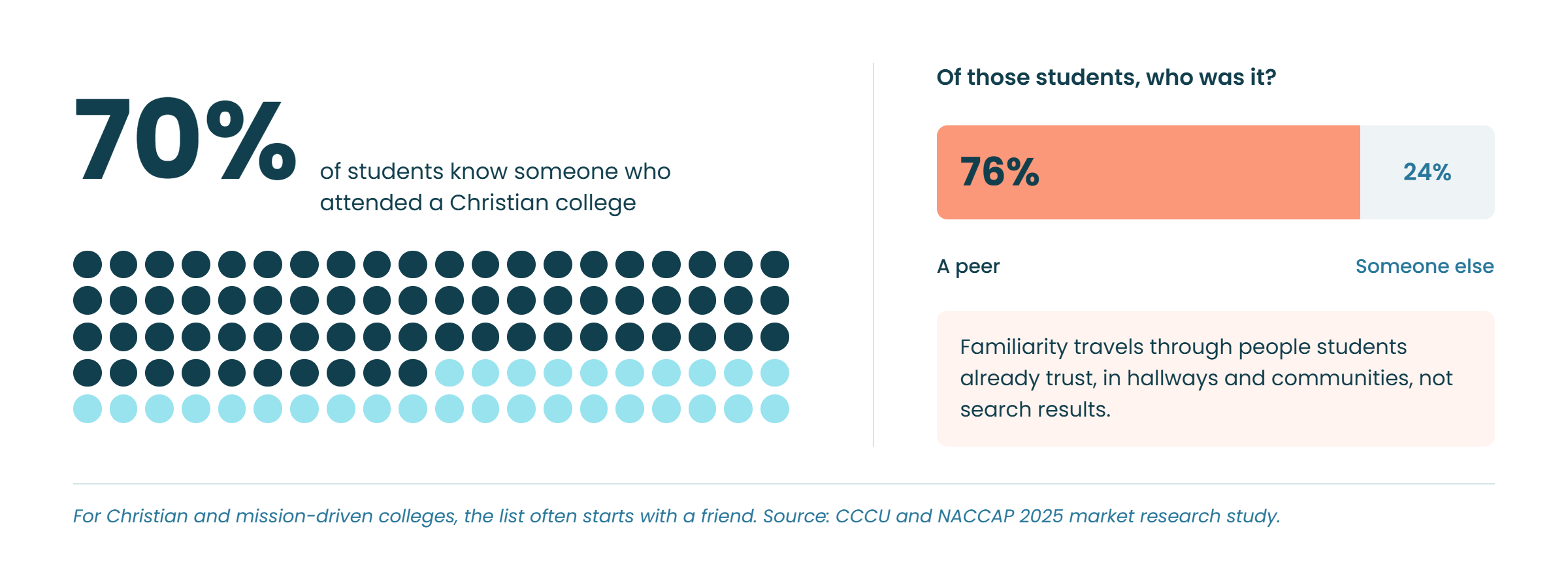
A 2025 market research study from CCCU and NACCAP found that 70% of students know someone who attended a Christian college, and 76% say that person was a peer. That's a different mechanism than a ranking algorithm surfacing a name. It's a student hearing about a school from someone they already trust, in a hallway, a church community, a transfer conversation, long before any search bar opens.
Familiarity built this way is a genuine advantage. It's also fragile in a specific way: it erodes gradually, showing up next cycle as fewer students mentioning the name and counselors hearing about the institution less often. The shift is usually invisible until enrollment softens and the institution is left tracing the gap backward. We've written before about how that erosion shows up late on a dashboard, and the behavioral science behind why repeated exposure matters this much is worth a closer look in The Mere Exposure Effect.
For a small private with a real story to tell but no budget for a major campaign, protecting that relational familiarity in the specific schools and communities that feed it is the highest-leverage thing marketing can do right now, because it's the one channel a large, well-funded competitor can't simply outspend.
Why This Keeps Losing the Budget Argument
Performance marketing produces clicks and conversions that are easy to defend in a meeting. Brand and awareness work produces familiarity that's harder to capture on the same dashboard, which makes it the easiest line item to cut when budgets tighten. We've made the fuller case for defending that budget line in You've Been Right About Awareness All Along.
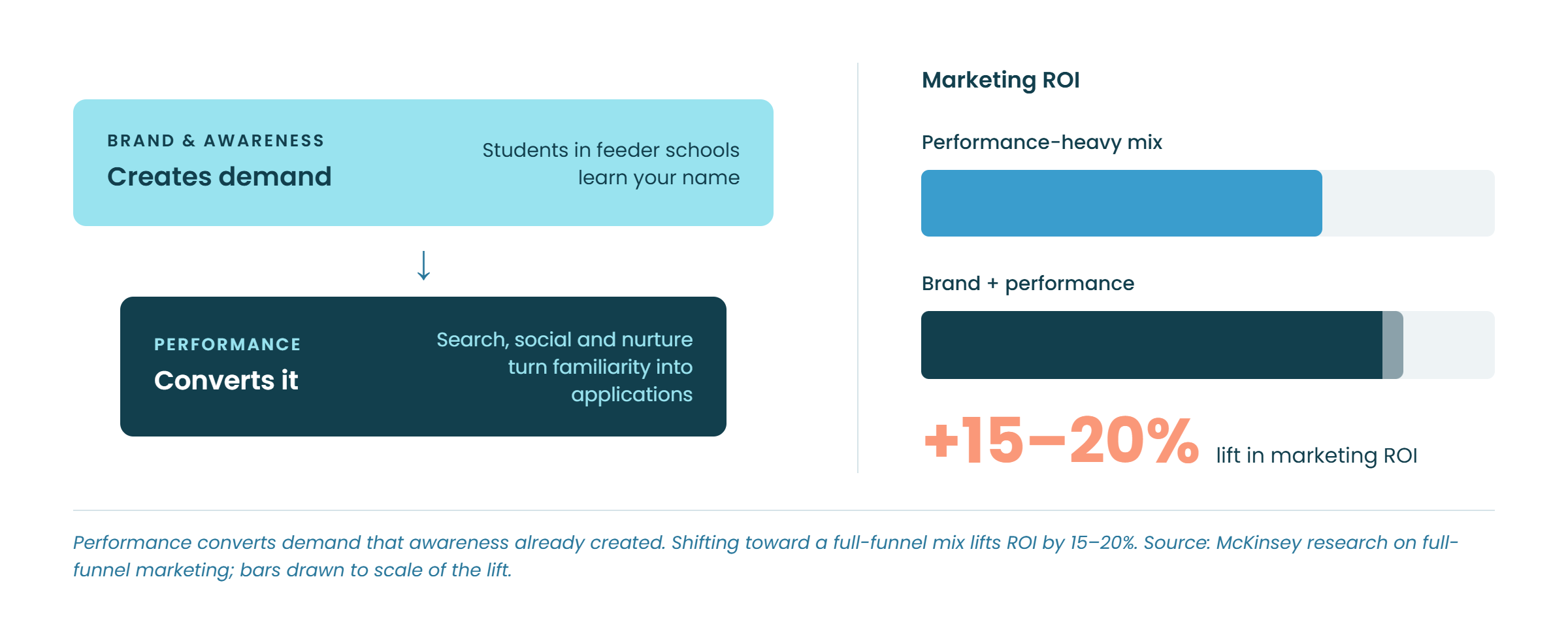
For small privates, the numbers back a specific version of that case. McKinsey's research on full-funnel marketing found that shifting media allocation toward strategies that combine brand and performance lifts marketing ROI by 15 to 20%, because performance converts demand that awareness already created. For an institution relying on regional, relational familiarity rather than national name recognition, that awareness spend isn't a nice-to-have ahead of performance marketing. It's the demand performance marketing needs in order to have anything to convert.
The Real Cost of Waiting
The window to maintain presence in a feeder region is smaller than most small institutions assume, and prevention costs less than rebuilding. Once relational familiarity fades in a community, restoring it costs more than budget. It costs time, internal approvals, and trust in a region that used to know the name.
For mission-driven colleges, the deciding factor is almost always visibility: whether students in the right schools, in the right region, encounter the institution before they've already built their list. Protecting that visibility, in the specific hallways and communities where it forms, is the one investment a small private can make that a bigger, better-funded competitor can't simply replicate.
