

You've Been Right About Awareness All Along. Here's Your Proof [Part 2 of 3]
If you read Part 1 of this series, you have the context. In May 2026, Google made AI Mode the dominant search experience globally. Students now get an AI-generated answer naming a handful of institutions rather than a page of links to click through. Everspring's 2026 research confirms the effect is already measurable in higher ed, with branded search volume declining rapidly across all institution types. And this summer, Google is rolling out background information agents that will build a student's consideration set over up to 18 months, without any outward signal you can capture.
The consideration set now forms before the search. It’s true that AI will surface plenty of institutions, and yours may very well be on that list. But the ones that land are the ones already carrying weight in a student's world before any session begins. Familiarity is what pushes you to the forefront.
If you've spent time defending the awareness budget in rooms full of people who want to talk about conversion rates, this moment has handed you the strongest argument you've had yet.
Here's the evidence and how to use it.
Why the Data Backs What You Already Know
You've been making the familiarity argument for years. The case for awareness spend has always been grounded in something real: people choose what they recognize, and recognition is built long before a student sits down to compare schools. The proof to put in front of a skeptical CFO has never been stronger.
The ideal condition for familiarity to take hold is daily, spaced repetition over a long period. A student passing the same screen in their high school hallway between classes, every day, for 2 years, is the textbook case.
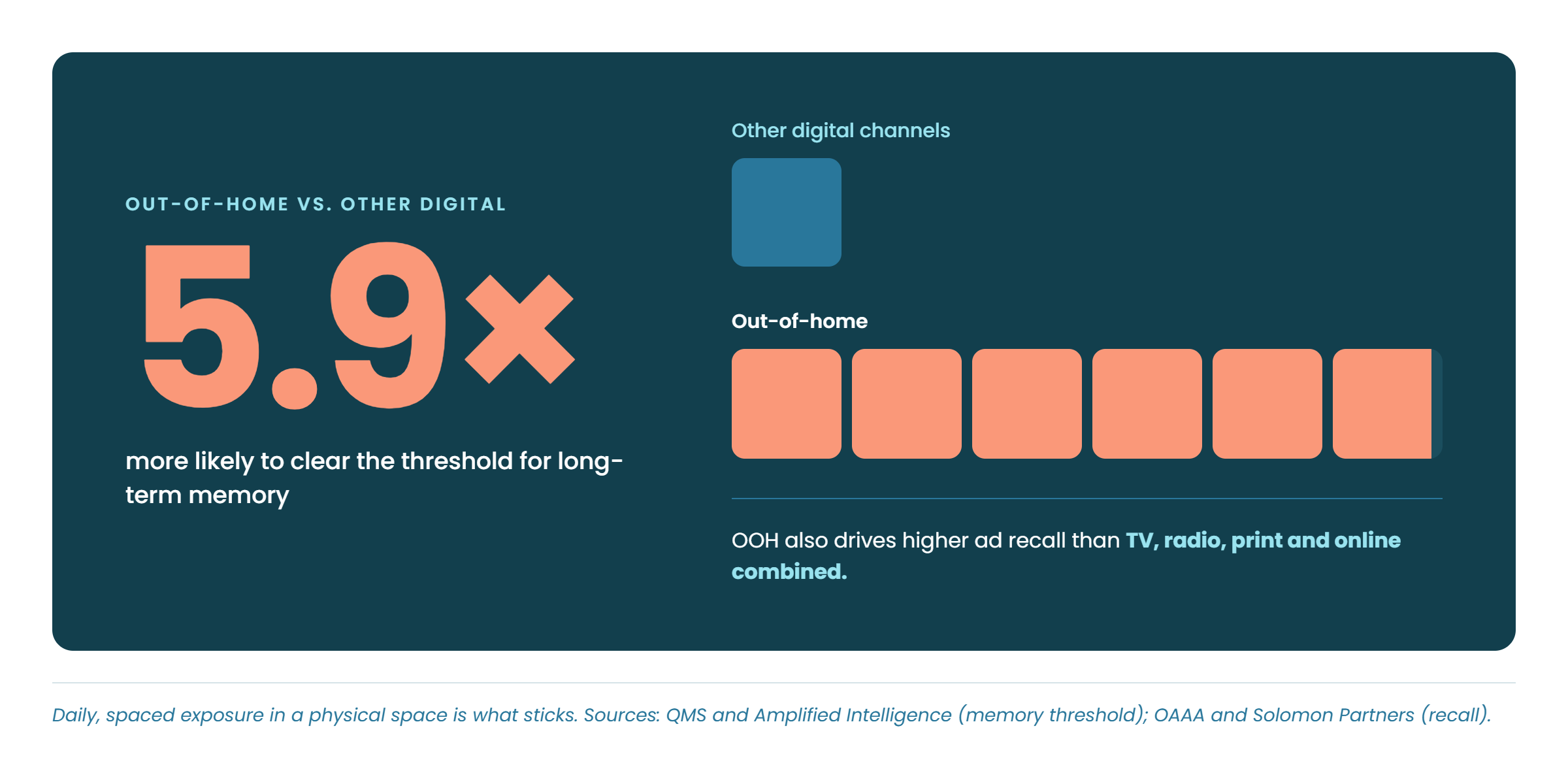
Out-of-home advertising research backs this with hard numbers. According to the OAAA and Solomon Partners' analysis of consumer data, OOH produces higher ad recall than TV, radio, print, and online executions combined. Research by QMS and Amplified Intelligence goes further: OOH ads are 5.9 times more likely than other digital channels to deliver above the global threshold for something to be committed to long-term memory.
The connection to AI is worth thinking through. A student who's already seen your brand on a screen is more likely to search for your institution by name when they open a search bar, or when an agent opens one on their behalf. That branded-search behavior builds your web-wide footprint. And that footprint is part of what AI draws on when deciding which schools to surface in an answer.
The direct path from physical presence → familiarity → consideration is the well-supported argument. The AI-feeding path is the upside, each link has logic behind it, but treat it as an amplifier, not proof.
Where Your Brand Needs to Live
A student's world has three surfaces, and they compound each other:
The school building is where familiarity takes root. It's the highest-dwell environment a 16-year-old occupies, and it's where counselors are present and actively shaping which schools students consider. In-school screens in hallways and guidance areas deliver daily, spaced exposure in that exact environment.
The scroll is where familiarity gets reinforced. Programmatic display, social, connected TV, and connected TV extend your presence across what students consume at home and on their phones, building on what they've already seen in their school.
The web is what the AI agent searches. Everything said about your institution everywhere, across every surface, is what an AI system matches against a student's criteria for months before they apply.
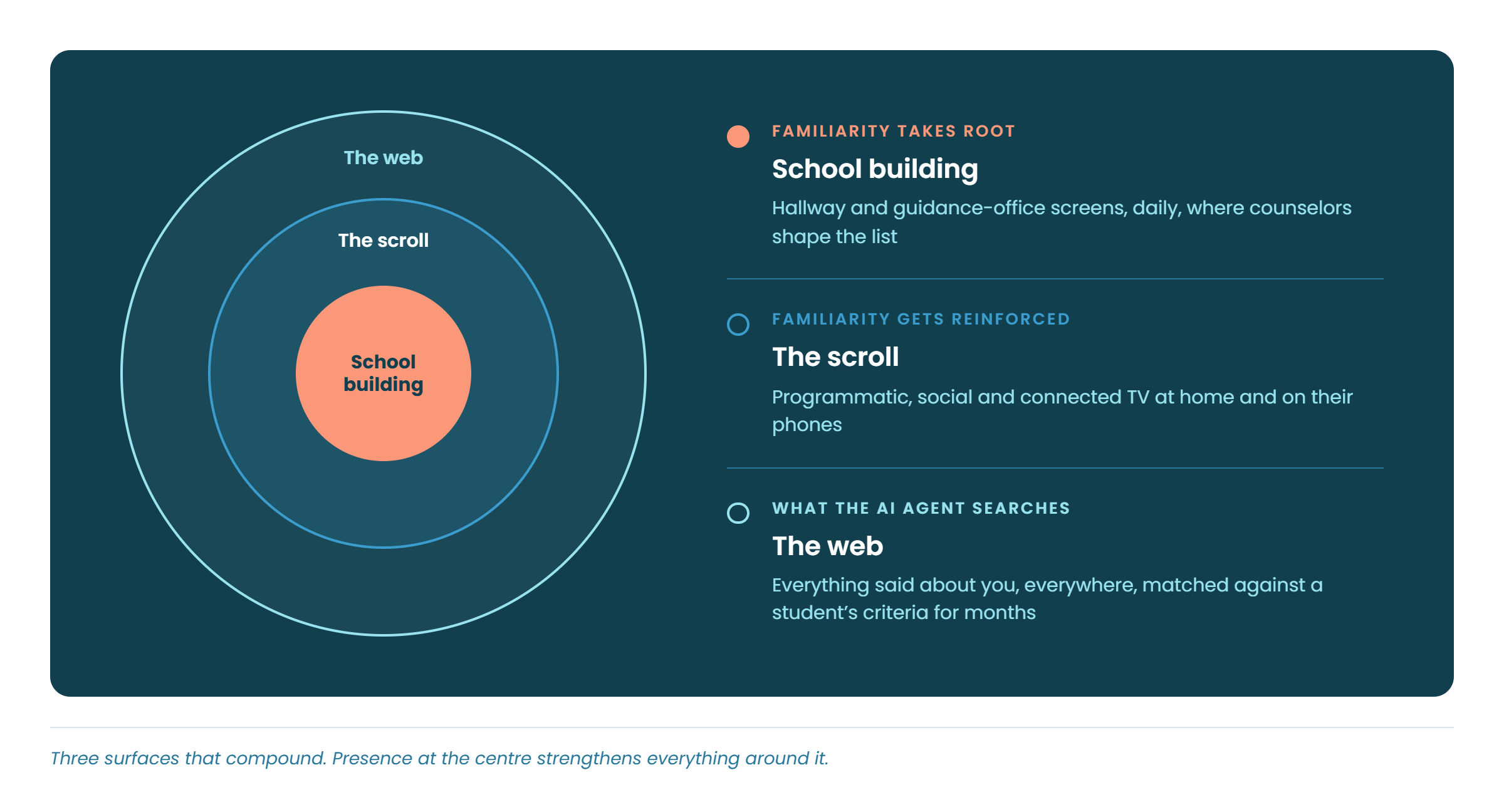
An institution consistently present across all three surfaces gets recognized. Recognition is what converts an algorithmically-eligible institution into the school a student applies to.
How to Win the Budget Room
The toughest room is the one full of people who believe performance marketing handles everything. The reframe that works is structural, not philosophical.
Performance marketing works on students who are already considering you, optimizing within a set that someone else defined. Awareness determines whether your institution is in that set at all. AI has now made the set-formation step earlier, more invisible, and further outside anything a funnel tactic can reach after-the-fact.
The question for your leadership: how much is it worth to be in the set before the set itself forms? That reframes awareness from a line item to a structural position in the enrollment funnel, upstream of everything performance marketing can touch.
For context on the window you're working in: EAB's national survey of over 5,000 high school students found 46% use AI in their college search, up from 26% the prior spring. That figure was taken before Google made AI the default. It's a floor, and the window before a student applies stretches 6 to 18 months. Familiarity built during that window shapes the list the agent produces.
What to Do Before Your Next Planning Cycle
Run your institution through Google's AI Mode. Search a relevant query: your region, your program type, your student profile. See whether you show up in the answer. The gap between where you rank in organic results and where you appear in AI responses is your visibility problem made concrete. It's also your most persuasive internal slide.
Audit your off-property presence. How consistently does your brand appear in the physical environments your prospective students occupy? High school hallways, guidance offices, community spaces. If the answer is sparse, that's the gap worth closing first, because it's the one performance tactics can't fill after the fact.
Reframe awareness as protection against a visibility gap. The case for awareness spend used to rest on brand-building timelines and soft metrics. It now rests on a structural fact: the consideration set forms upstream, in AI, before any performance tactic can reach it. Real-world presence is the tool that works in that window.
Next up: Part 3: By the Time They're in Your CRM, the Decision Was Already Made. For admissions and enrollment leaders: stealth applicants, the invisible top of funnel, and what to do about it.
Earlier in this series · Part 1: Google Just Rewrote the Rules. Here's What That Means for Higher Ed. The structural shift in search, what Google announced, and why familiarity is the real filter.
