

It's 2026. Your applicants have stopped typing your name into Google.
Branded search across higher ed fell 22% between March 2024 and February 2026, according to research from Everspring tracked across 120+ institutions.
Students have replaced institution name searches with outcome-based questions: what a degree leads to, what it costs, which programs fit a career path. AI now answers those questions before a student ever lands on an institution's website.
The decline hits some segments harder than others. Flagship and research universities lost 16% of branded search. Private nonprofit institutions lost 28.8%. Regional and comprehensive schools lost 29.1%, nearly double the flagship rate.
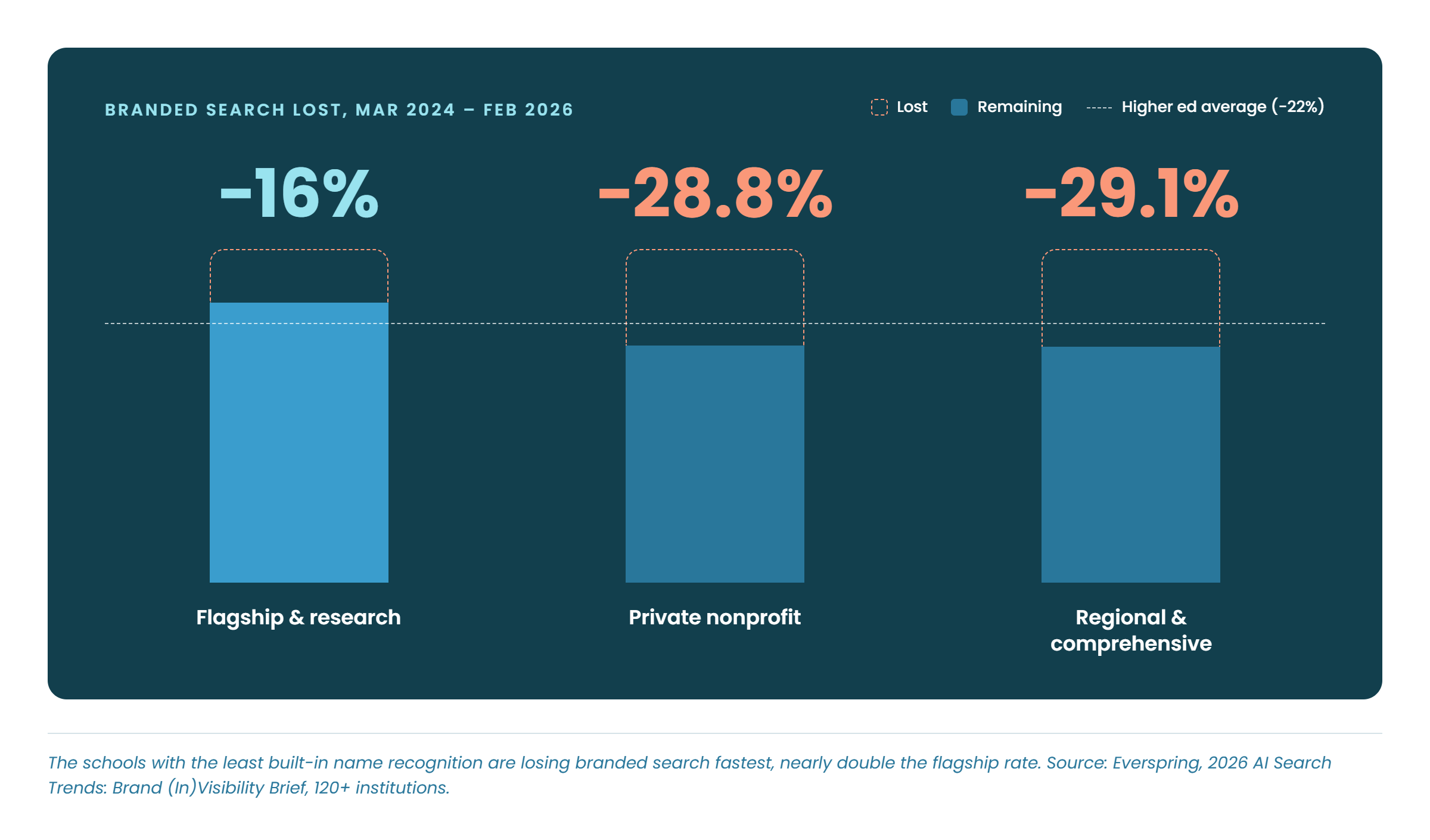
The 22% headline is an average sitting on top of a sharper split: the institutions with the smallest built-in name recognition are losing recognition-driven discovery the fastest.
The awareness gap doesn't open evenly across higher ed. It opens widest for the institutions that can least afford it.
What replaced the branded search
Students are asking outcome questions now, like what a psychology degree leads to or how much a bachelor's degree costs, and getting answers directly inside Google's AI Overview, often before visiting an institution's site at all.
Everspring's data ties that Overview placement to conversion. Roughly 1 in 4 students who reach a site through organic search go on to start an application, the highest rate of any major channel Everspring tracked. Top-ranked pages can lose close to 90% of their traffic once an AI Overview appears above them. Winning that Overview citation is what triggers the inquiry. Missing it means missing the moment entirely.
Why keyword volume doesn't close the gap
Flagship universities carry roughly 2.6 times more ranking keywords than private nonprofit or regional schools, built largely on brand mentions in news coverage, rankings lists, and press releases. That volume corresponded to low AI citation instead: the flagship examples Everspring cited ranged from 1-9% in non-branded AI answers, while the private institution examples ranged from 16-24%.
Across Everspring's full dataset, private institutions running mostly non-brand content, informational blogs, career guides, program explainers, were cited 10 to 20 times more often than flagship schools with brand-heavy keyword mixes.
That's a real finding, and it's squarely Everspring's specialty to help institutions build that kind of content. Getting surfaced by AI and getting chosen by a student are two different problems.
Brands were never just a website
It's worth naming a bigger point underneath all of this. Dayana Kibilds, writing for Simpson Scarborough, argues that treating a website as the home of a brand was always a convenient fiction.
People don't form attachment to a brand by reading a summary page. Kibilds writes that brands are experienced as accumulations, a slow layering of encounters that form an identity over time, not as any single curated moment.
That reframes what's actually happening with AI-driven discovery.
It's not creating a new problem so much as removing the illusion that the website was ever fully in control of brand perception. A prospective student's sense of an institution was always built from scattered touchpoints: a counselor's comment, a campus visit, a friend's older sibling, a screen in a hallway they passed twice a week for a year.
The website summarized that impression. It rarely built it.
Surfacing and choosing are different problems
AI generates the option set. Familiarity decides which option a student trusts enough to click. When a student's search returns 5 schools, 4 they've never encountered and 1 they've walked past in their own hallway for a year, familiarity does the filtering that ranking alone can't do.
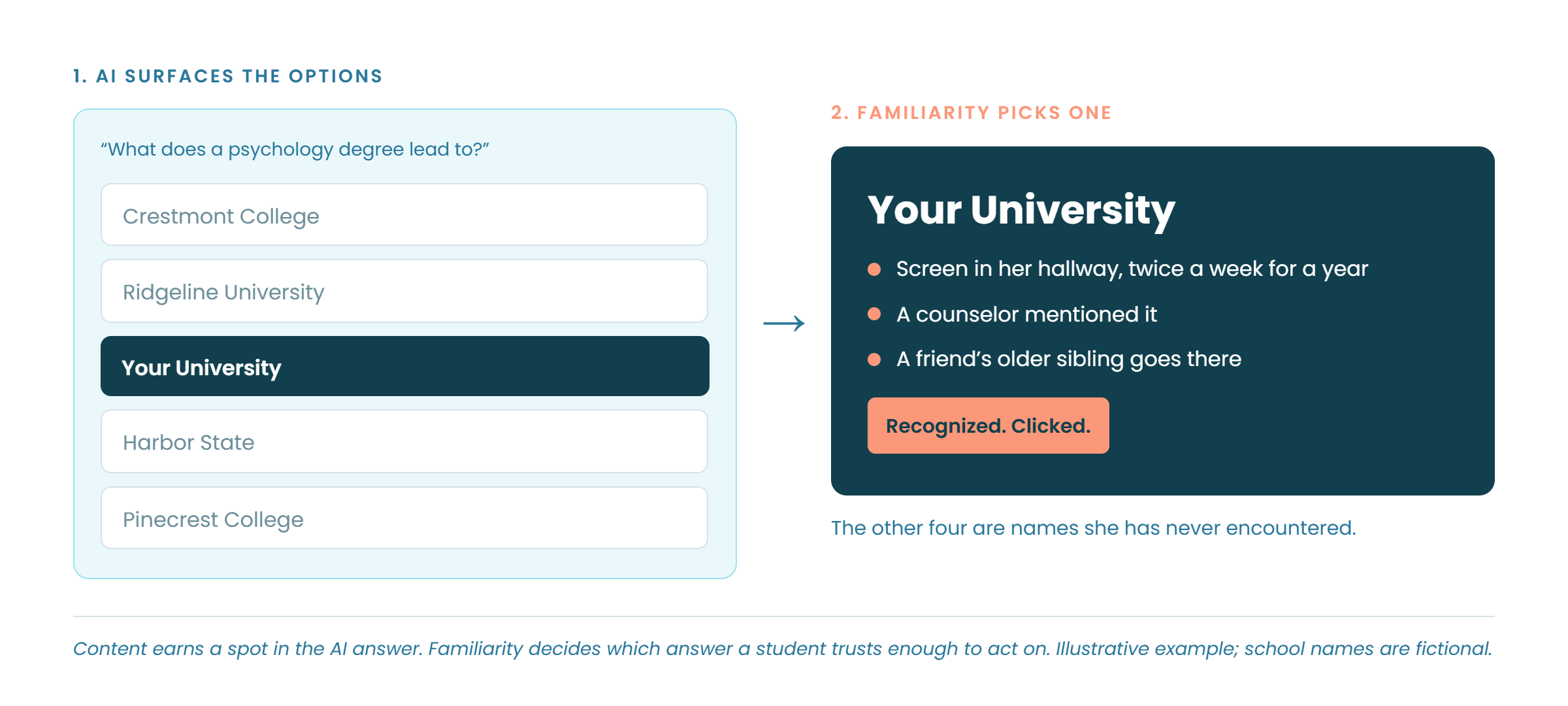
This is the mechanism behind the mere exposure effect: repeated exposure builds a subconscious sense of trust before any active evaluation begins. Strong content earns a place in the AI answer. Familiarity determines whether a student recognizes that answer as something worth acting on.
That's the upstream problem OnDeck solves, through in-school screens and digital reinforcement working together. Neither channel is a substitute for the other. Both build the same baseline of recognition before a student ever opens a search bar, through the same kind of accumulated, real-world moments Kibilds describes. When a student does search and AI returns your program next to names they've never seen, your institution already holds a place in the consideration set, because it was already part of that constellation of moments before the search began.
Why this changes the budget conversation
The old argument for awareness spend leaned on branded search as proof the spend was working. That argument gets harder to make every quarter, because branded search is contracting fastest for the institutions relying on it most.
The stronger argument: familiarity built before a search happens is what keeps an institution in a student's consideration set once AI has already narrowed the field down to a handful of names. That's structural risk, and structural risk survives a budget review in a way a traffic spike doesn't.
We built Before the Search around this shift, what it means for how enrollment leaders think about awareness, and how to make the case internally before the next budget cycle forces the conversation.
Everspring's report makes the case for how to get surfaced. Simpson Scarborough makes the case for why familiarity was never really about the website to begin with.
