

Google Just Rewrote the Rules. Here's What That Means for Higher Ed [Part 1 of 3]
At Google I/O in May 2026, Google made a move that deserves more attention than it's getting inside higher ed offices.
AI Mode has surpassed 1 billion monthly users, and Google announced what it called the biggest upgrade to the Search box in over 25 years, now powered by Gemini 3.5 Flash. Classic blue-link results still exist, but the experience now leads with AI, and queries into AI Mode have more than doubled every quarter since launch.
Here’s the part that matters most: Students didn't leave Google for AI. Google became AI.
That's a different problem than the one most enrollment teams are currently solving for.
This is a 3-part series that breaks down what this change means for higher ed and where the opportunity to respond sits. Start here.
This Is a Different Kind of AI Shift
Google has been layering AI into search for years, and higher ed has largely kept up. What happened in May 2026 is a different kind of change.
Previously, a student searching "best business programs in the Southeast" got a list of links. They clicked through, compared pages, scrolled through programs, maybe even bookmarked a page for later. Your website was in the running.
Now, that same search returns an AI-generated answer naming 3 or 4 institutions, summarizing program strengths, listing tuition ranges, and noting outcomes. The answer feels complete, and many students never click a single link.
Even before Google made their latest AI-as-search announcement, the data was already making a compelling case. Ahrefs found that the presence of an AI Overview correlates with a 58% lower clickthrough rate for the top-ranking page. Everspring's 2026 research confirms the effect is landing hard in higher ed specifically, with branded search volume declining across all institution types. And the overlap between top-10 organic rankings and AI overview citations collapsed from around 75% in mid-2025 to between 17% and 38% by early 2026.
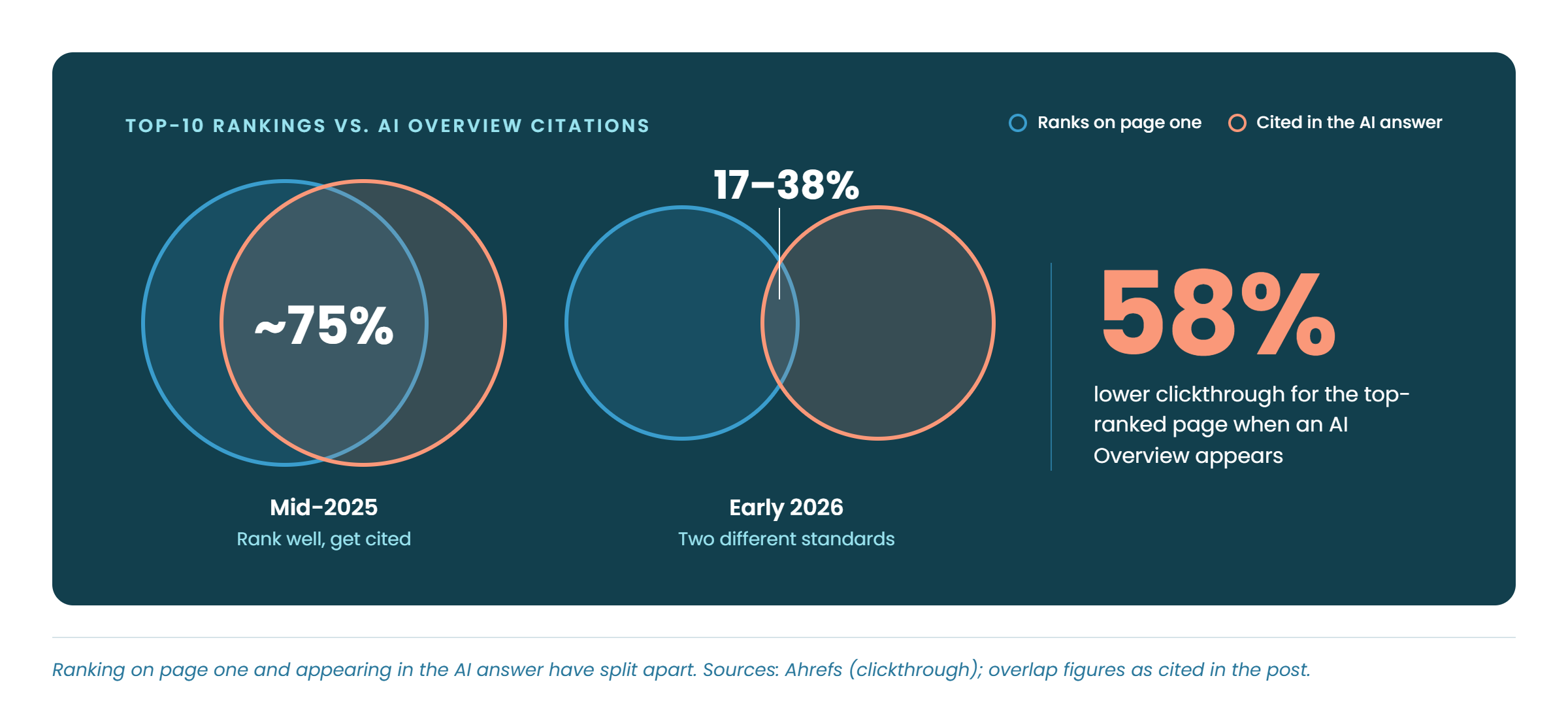
The Google I/O announcement sharpened what the data was already showing. Ignoring it just got a lot harder. Ranking on page one and appearing in the AI answer are two completely different standards now. And the response to that gap is not more SEO.
The Second Shift Is Already in Motion
Alongside the AI Mode announcement, Google signaled the rollout of information agents this summer. A student sets one up once and inputs their criteria: location, program type, cost range, campus size. The agent then runs continuously against the entire web on their behalf, for months, before they ever open an application.
The student stops actively searching. The agent finds matches on their behalf, in the background, for anywhere from 6 to 18 months.
Think about what that means for the search session you've spent years optimizing for. By the time a student opens an enrollment application, more of the consideration process has already happened than any institution can observe. It formed algorithmically, without a single click you could track.
The consideration set is now assembling upstream, out of view, earlier than it ever has. That's the structural shift underneath the headline numbers.
The Institutions That Make the Cut Aren't Who You'd Expect
Here's where the story gets useful, because the answer to "how do you make the AI's list?" is not as simple as "optimize harder for AI."
An agent narrows a student's universe down to a handful of schools over 18 months of matching. But which one does that student pursue? Research from Advance Education is clear: students start their college search with people, not platforms. Family, friends, teachers, and counselors shape which schools make it onto a student's radar before any search session begins. Eduventures puts it at 86% of college-bound students citing at least 1 influential individual in shaping their consideration set.
Students don't walk into AI sessions with a blank slate. They bring what they already know, what feels familiar, and which names have shown up in their world, even subconsciously. The school their counselor mentioned. The one they've walked past on a screen countless times on the way to class.
The AI agent works from that starting point.
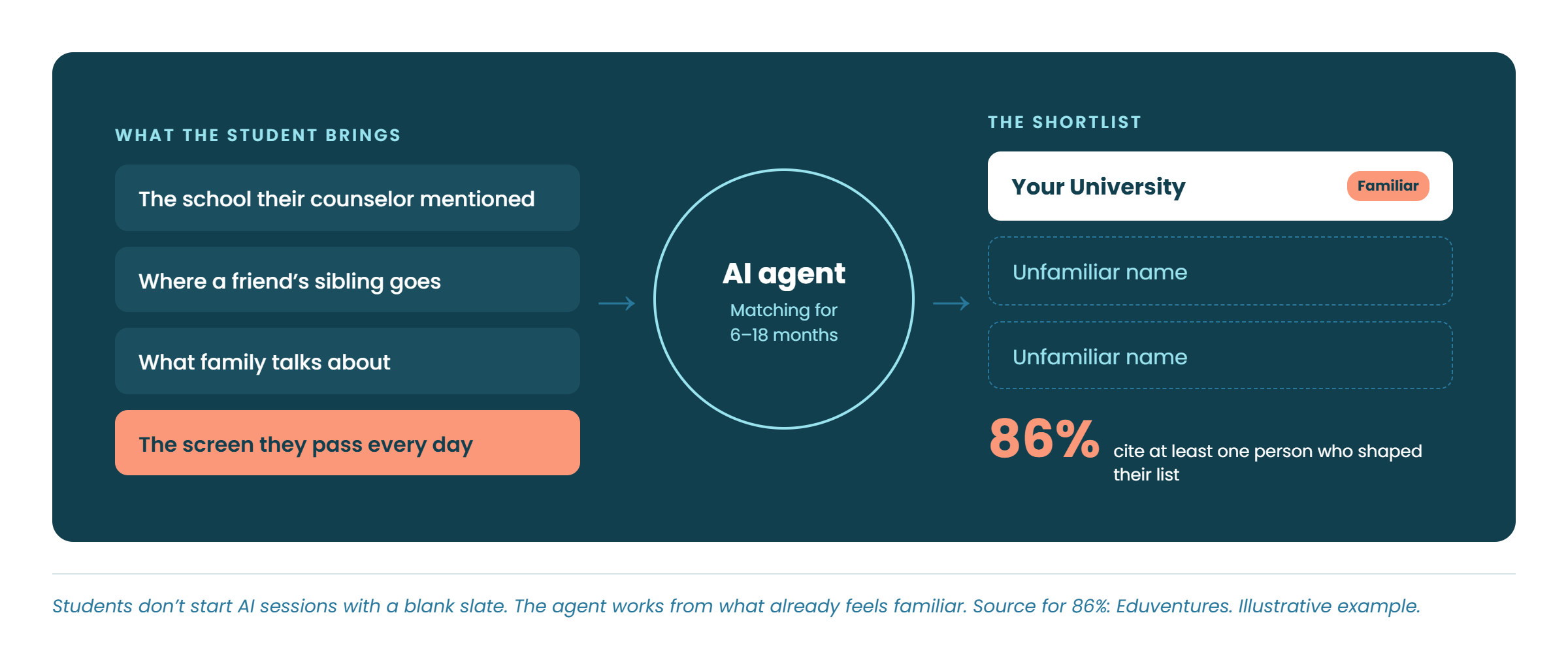
When a student narrows their search from dozens of options to the handful they'll ultimately pursue, familiarity shapes the final cut too.
There are 50 years of behavioral science behind this pattern. The mere-exposure effect, first documented by Robert Zajonc in 1968 and replicated in over 200 studies since, shows that people consistently prefer what they've already encountered, even without any other information to support that preference. A familiar name feels more credible than an unfamiliar one, regardless of what either institution offers.
Daily, spaced repetition over a long period is the ideal condition for that effect. A student passing the same screen between classes for 2 years is the textbook case.
The institutions that win in an AI-mediated discovery world are the ones students already know. Put simply: familiarity is the thread that runs through the whole process, from the first input to the final decision.
Nobody Else Owns the Hallway
You'll see a lot of vendors in the coming months selling GEO (generative engine optimization), AI-readiness audits, and content restructuring. That work addresses a real layer of what's happening, and some of it is worth doing.
What it leaves unaddressed is whether your institution already carries weight in a student's world before any AI session begins. AI will surface plenty of institutions a student has never heard of. The ones that land are the ones that already feel familiar, the ones that showed up in the places, conversations, and environments that shaped what a student believes is worth considering, long before they opened a search bar.
OnDeck builds that real-world brand weight. In-school screen presence that puts your institution in front of students and counselors daily, in the building where consideration forms. We're on the off-property, in-the-real-world side of this conversation. Nobody else in this space owns the hallway.
Worth sitting with before your next planning conversation: if a student never visits your website, would they still know your name?
Next in this series · Part 2: You've Been Right About Awareness All Along. Here's Your Proof. For higher ed marketers: the OOH data, the familiarity mechanics, and how to defend awareness spend in any room.
Part 3: By the Time They're in Your CRM, the Decision Was Already Made. For admissions and enrollment leaders: stealth applicants, the invisible top of funnel, and what to do about it.
