

The Mere Exposure Effect: What Neuroscience Tells Us About How Students Choose Institutions
There's a moment every enrollment marketer recognizes.
A student shows up at an open house, engaged, asking good questions. When you ask what brought them in, they say some version of: "I've just always heard of you." They can't point to an ad. They can't name a moment. The institution feels familiar, and that familiarity was enough to put it on the list.
That's behavioral science at work. And understanding it changes how you defend awareness spend.
The science has a name
In 1968, psychologist Robert Zajonc published a finding that has since become one of the most replicated results in behavioral science. His conclusion: repeated exposure to a stimulus increases a person's positive attitude toward it, even without any conscious engagement with that exposure.
He called it the mere exposure effect.
The mechanism works like this. When we encounter something repeatedly, the brain processes it with progressively less cognitive effort. That processing fluency registers as familiarity over time, and familiarity in human psychology sits very close to preference. We favor names, brands, and faces that have shown up in the background of our lives, often without being able to explain why.
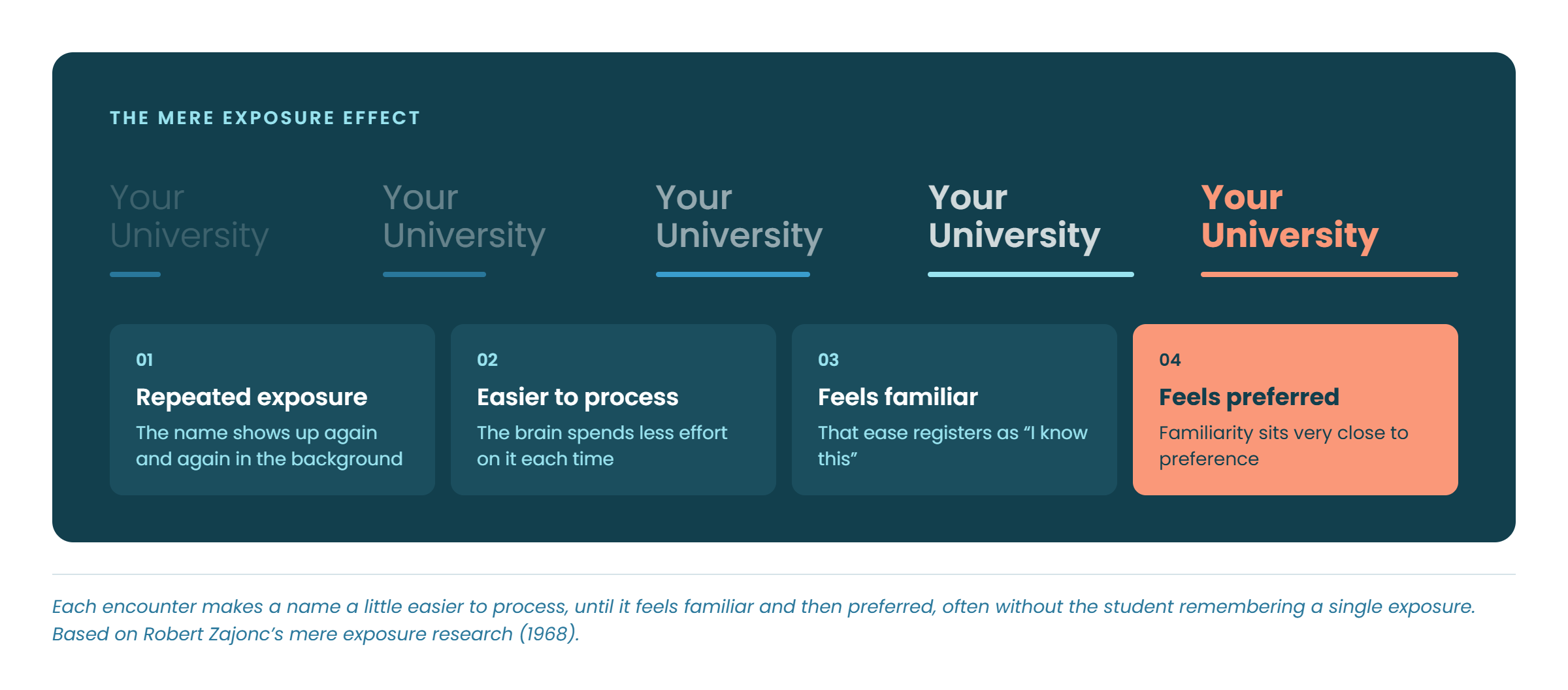
The effect has been demonstrated across languages, images, sounds, and brand names. It holds whether or not subjects consciously remembered the exposures. In many studies, the effect was strongest among subjects who had no recollection of seeing the stimulus at all.
What this means for how students build shortlists
A high school student doesn't sit down in junior year and neutrally evaluate every post-secondary institution available to them. What happens is more gradual. A consideration set forms over years, through ambient exposure to names and brands in the environments students move through daily. By the time a student opens a browser to begin a formal search, most of the real sorting has already happened.
Familiarity is what gets an institution onto the consideration set in the first place. From there, students evaluate based on what actually matters to them: program fit, location, cost, campus culture. But an institution that never built familiarity rarely gets the chance to be evaluated at all. That gap is particularly pronounced for students without family experience in post-secondary education, or without access to strong advising, where ambient exposure often determines what options feel worth exploring.
For those students, what's on the screen in their school building often isn't supplementary information. It's the primary information.
This is the mental real estate argument. The institutions that occupy space in a student's ambient awareness early and consistently are the ones that get included on their mental shortlist. That space doesn't accumulate through a well-timed campaign or a lead-capture form. It builds through consistent, low-stakes presence in the environments students inhabit every day.
The enrollment problem this creates
Higher education marketers are practiced at measuring what happens late in the funnel. Yield rates, application sources, visit conversions. Those numbers matter. The critical gap is that these indicators are downstream measures, effects of decisions shaped months or years earlier.
By the time a student is in your CRM, you're working with what awareness built before your campaigns started.
Awareness gaps compound long before enrollment drops. When a student doesn't encounter your institution during the years they're absorbing ambient information about their options, they don't rule you out. They never include you. The shortlist that forms before intent arrives doesn't have your name on it, and earning a place on that list from scratch at decision time is a significantly harder lift than being chosen from names that already feel known.
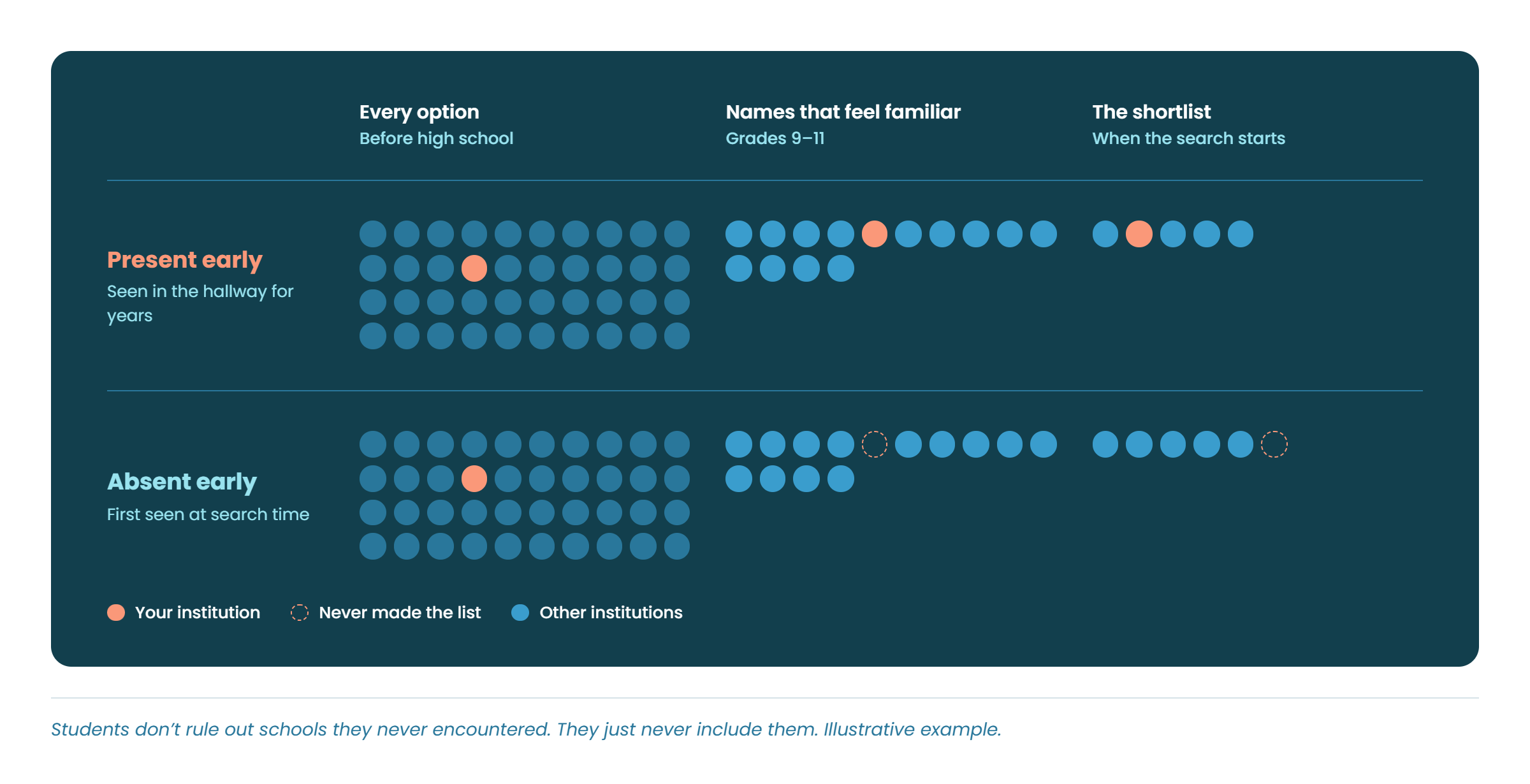
The visibility decline shows up in your data late. It surfaces as softer inquiry momentum, weaker brand recall, students who applied to several other institutions and never put you on the list. The easy read is that something went wrong at decision time. The harder truth is that the gap opened years earlier, when the institution wasn't present during the years familiarity forms.
The argument worth making in the room
When awareness spend gets challenged, the conversation usually hovers around attribution. "What did we get for this?" The demand is for performance math to be applied to a channel that doesn't behave like a performance channel.
The mere exposure effect gives you a structural answer. Students form preferences through repeated, low-stakes contact with institutional names over years. Their consideration sets solidify early. The shortlist a student brings to decision time didn't form during their college search.
Presence in the environments where students spend their school days, consistently and over time, is what earns a position on that list. It's grounded in real science, and it's the same logic that defends every awareness budget where the return is real but not directly traceable.
That presence can come from many channels. But the environments students move through daily (their school hallways, the spaces between classes) are where the ambient exposure compounds most reliably. Presence there isn't supplementary to digital. It's foundational to how digital awareness even registers.
As enrollment marketers, you're protecting mental real estate in the years before intent forms, because reclaiming that position later costs significantly more than holding it. The mere exposure effect doesn't describe a campaign outcome. It describes a long game. The more useful question isn't about spend at all. It's whether you've been present long enough for familiarity to do its job.
