

Locking In: 5 Ways to Get Noticed by Gen Z This Recruitment Cycle
Every higher ed conference this year has featured the same keynote in a different outfit (and no, this time we’re not talking about AI).
It’s this: How do we actually stand out? How do we get a 16-year-old to stop scrolling long enough to remember our name?
Fair questions. Your school is competing with every other school, plus every creator, game and group chat on a student's phone. That’s a whole haystack of content.
Part of the problem is that most messaging from colleges sounds exactly the same. Andy Murphy, Director of Marketing at Siena University stated it bluntly on a recent episode of OnDeck & OffScript: "Higher ed has a sameness problem. Everyone says 'community', everyone says 'professors know your name', and everyone says 'you're gonna belong here'. Plug any college into an email and you're gonna get the same thing."
We recently had some fun on LinkedIn remixing classic ad copy in Gen Z slang, and it got us thinking bigger. Speaking students' language is one way to get noticed. Here's how to do it well, plus 4 more ways backed by what students are responding to right now.
1. Speak their language
Students notice the moment a message was written for someone else. In EAB's survey of 5,000+ high school students, more than half said they'd react negatively to college messages they thought were AI-generated. Generic reads as a red flag.
The fix starts with the basics, like getting location-specific copy right. In the U.S., it's enrollment, school counselor and senior year. North of the border, it's enrolment, guidance counsellor and Grade 12. One extra "L" (or a "missing" one) tells a student right away whether the copy was written with them in mind.
Students also have a language of their own, and they use it all day in group chats and comment sections. Meeting them there shows you've been listening.
Here's what a little more Gen Z nerve looks like in practice:
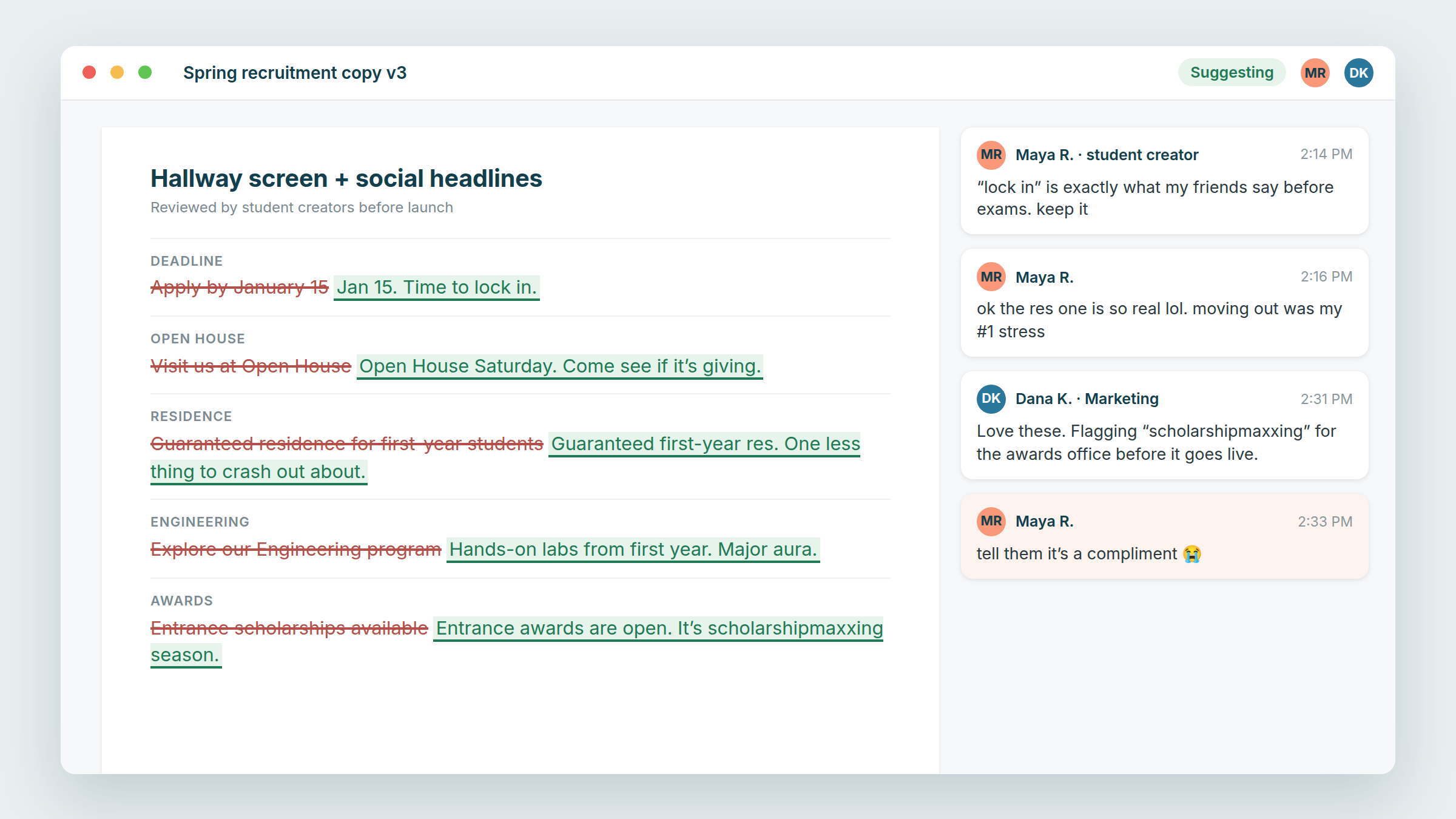
Notice who's in the margins. The student creator signs off on the slang before it ships, and marketing flags the one line that needs a second look. Same facts, different voice, and a real student checking whether it lands.
Patrick Stone, Director of Strategic Communications and Marketing at Cape Cod Community College, didn't sugarcoat it on another recent episode of OffScript: "your marketing sounds like meeting minutes." His fix: "Have fun, take big swings, be creative."
We'd take it one step further. If boring, forgettable copy is the norm, then playing it safe has a real price. Most teams treat bold creative as the risk. We'd argue the bigger risk is spending a full recruitment cycle on work nobody is going to respond to. That cost never shows up as a line item. But it will show up as an awareness gap, and those gaps compound long before they hit an enrollment report.
If you're thinking about taking a swing, we’d suggest running it with one ground rule: first, run it past real students, because if a 16-year-old cringes, the hallway will too. And expect a short shelf life: today's aura is next year's "on fleek."
2. Hand the mic to students
Students trust other students more than they trust your brand guidelines.
Andy Murphy's answer to the sameness problem comes down to authentic storytelling. "Yes, we have a community at [our college], but my top five competitors are also saying that exact same thing," he told us. "Being able to be effective storytellers is critical."
And your current students are the best storytellers you have.
RNL's 2025 E-Expectations research found that posts showcasing their real campus experiences were the content students most wanted to see, at 39%. Accessing “student life content” is also the #1 reason students follow a college on social, as cited by 37% of respondents.
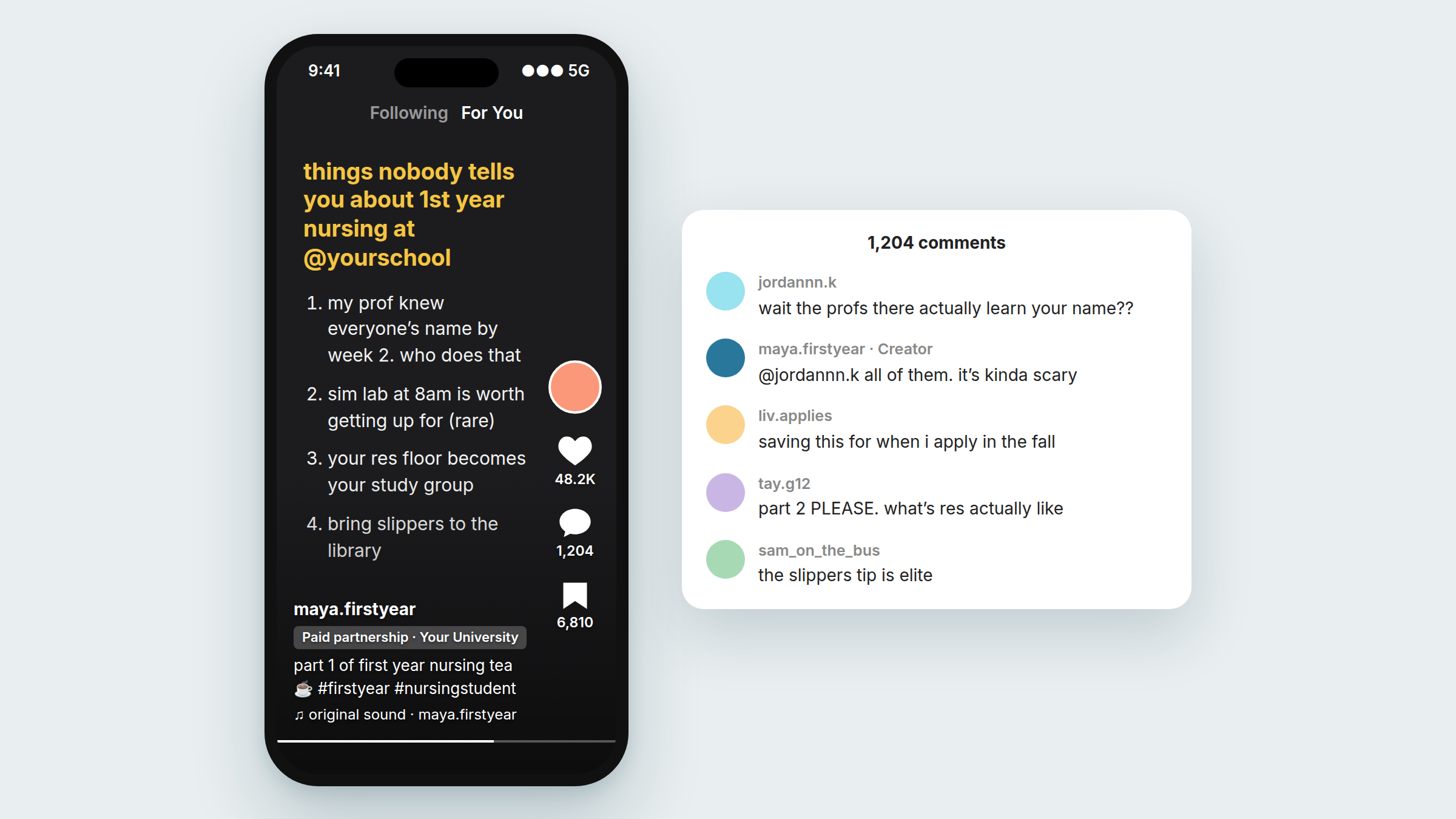
Look at what's working in that sample post above. It's a Notes app list typed up between classes, with no logo, no b-roll and no script. The prof who learned everyone's name by week 2 does more for the nursing program than any viewbook line about small class sizes. And the comments are where it pays off: prospective students asking follow-up questions, saving it for application season, begging for part 2.
The best student content tends to look a bit unfinished, or dare we say, unfiltered. That rawness is the credibility.
Here's the part that gets skipped. You're asking students to put their face and their name on your brand. Treat that like the job it is:
Pay them. An hourly wage or a real stipend. A free hoodie is a tough sell to someone working 2 other jobs.
Hand over the creative. Give them the program and the date, and let them pick the angle and the jokes. If every video goes through 4 rounds of approval, it comes back sounding like the viewbook.
Credit them by name. Their handle, their program, their year. Your creators deserve the portfolio piece.
Invest in them. At Amherst College, Stephanie Ramírez runs a team of 8 to 10 student creators who put in about 4 to 6 hours a week. When students started feeling disconnected, she rebuilt the program around weekly meetings and mentorship, and trained them in brand voice, accessibility and campaign planning. The payoff shows up in their pitches, which start to account for audience and brand voice.
Look past the usual ambassadors. First-gen, transfer, commuter and rural students reach the students who don't always see themselves in the tour guide.
One caution: real means real. Students can spot a scripted "day in the life" from a mile away. They've grown up inside advertising, and authenticity is the filter they run everything through.
3. Go short and go vertical
Short video stays winning (as the kids say). The 2025 Higher Education Social Media Engagement Report from Rival IQ and Quid found short video posted the highest median engagement rate in its analysis, at 11.80%, with carousels piling up engagement through swipes and saves.
There's also room to grab. RNL found 63% of students are on Instagram, but only 53% are seeing college content there. That 10-point gap is open territory.
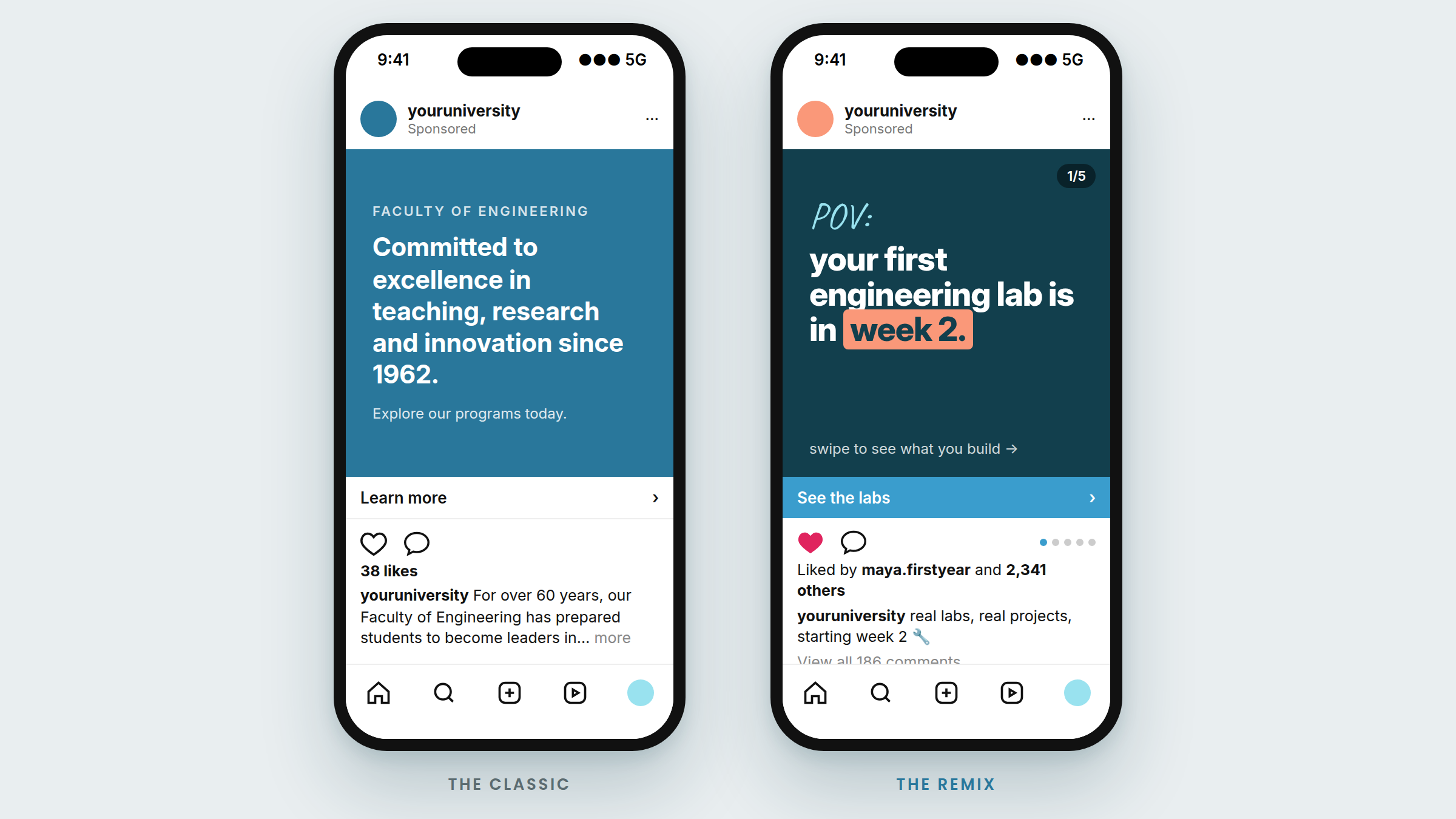
The type of content you post matters. Look at the example above. Both posts are selling the same engineering program. The classic opens with the faculty's history and makes the student read 4 lines before they learn anything about their own life there. The remix opens with what a student cares about, their first week, and uses the carousel to pull them into slide 2. Whether it's a 20-second video or a 5-slide carousel, the rule holds: hook first, logo later.
From there, reuse what you've got, with one adjustment. Higher Education Marketing's 2026 social trends guide recommends making a separate version for each platform instead of posting the same watermarked video everywhere. Students notice when a clip was made somewhere else and dropped in. A good 20-second student clip from #2 still does the heavy lifting. Give it a fresh edit, native captions and the right length for each feed, and for a screen in a high school hallway.
4. Show up in the AI answer
A growing share of students meet your school through a chatbot or AI search before they ever hit your website. EAB found 46% of high school students used AI tools like ChatGPT in their college search in fall 2025, up from 26% that spring. Nearly 1 in 5 removed a college from their list based on what AI told them.
Getting noticed here comes down to something a lot less sexy: housekeeping.
Keep program pages current, specific and consistent: tuition, deadlines, outcomes, admission requirements.
Answer the questions students ask in plain language, in FAQ form, on pages you own.
Ask a few current students what they typed into ChatGPT when they were applying. Their answers make a great FAQ list.
Check what the major AI tools say about you today. If it's wrong or out of date, that's your to-do list.
The student voices from #2 help here too. First-person content is the kind of material search and AI tools favour.
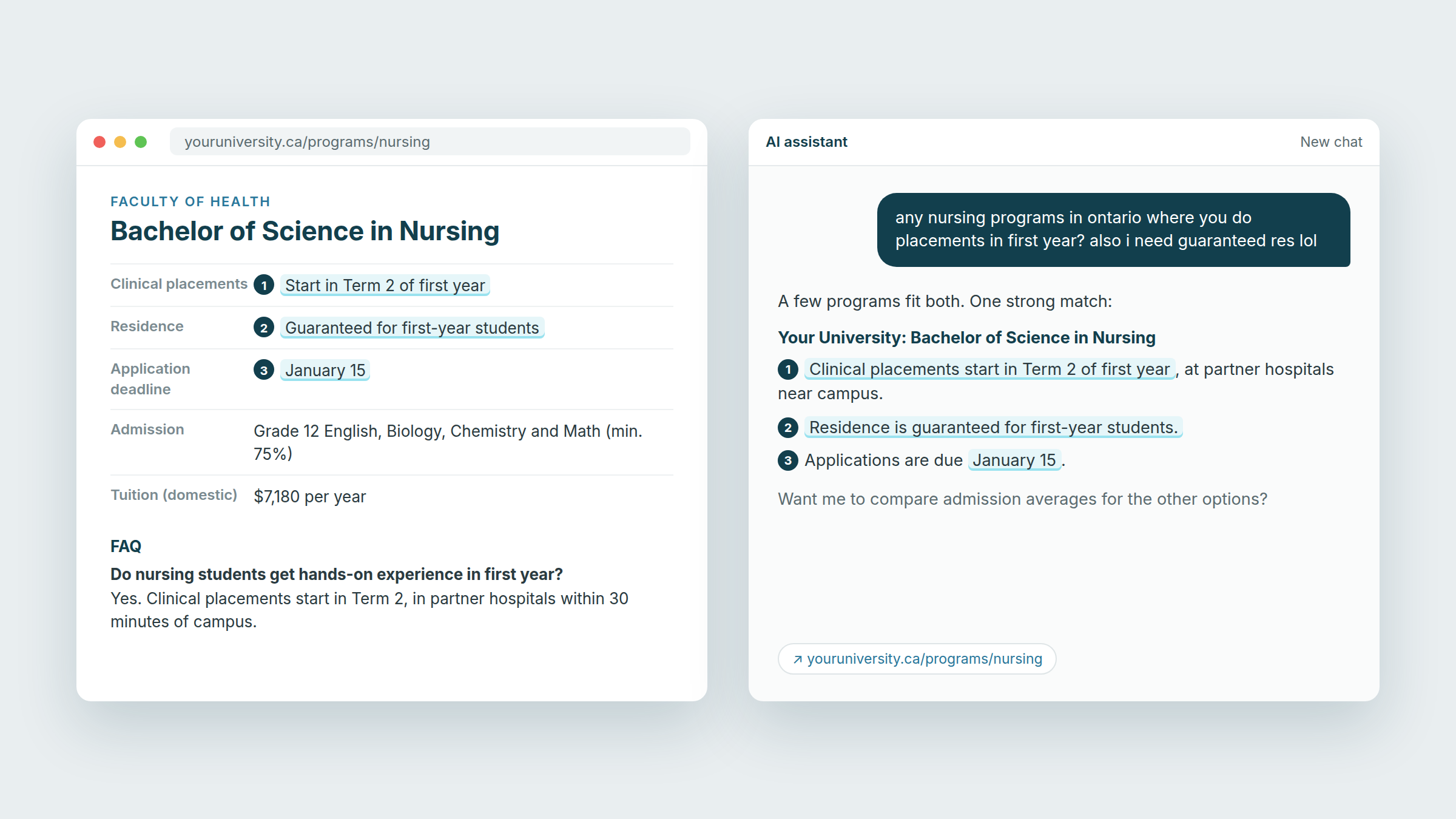
The webpage on the left won't win any design awards. It's a facts table and one FAQ. But when a student asks about first-year placements and guaranteed res, every line of the AI's answer traces back to it. Specific, current, consistent pages get quoted. Vague ones get skipped.
5. Get there early, and be IN the building
The window to get noticed opens earlier than most recruitment calendars assume. EAB's data shows 9% of the Class of 2025 had inquired with a college by October of sophomore year, compared with 5% of the Classes of 2022 and 2023.
First impressions also fade as the search goes on. RNL found 56% of students say social media matters most when they're first exploring colleges, and only 21% say it still plays a big role once they're accepted. The schools on a student's early shortlist got there before the viewbooks arrived.
Their social feed is one place to show up early. Their high school hallway is another, and it's the one space every student walks through, every single day. That matters most for the students your other channels miss: the ones who skip info sessions, rarely visit guidance and follow zero college accounts.
A career counsellor at a Canadian high school sees the effect every month. When a new program shows up on the screen outside guidance, a student often comes in asking about it within a week. His take: "Students definitely notice it. They know it's there. They ask questions."
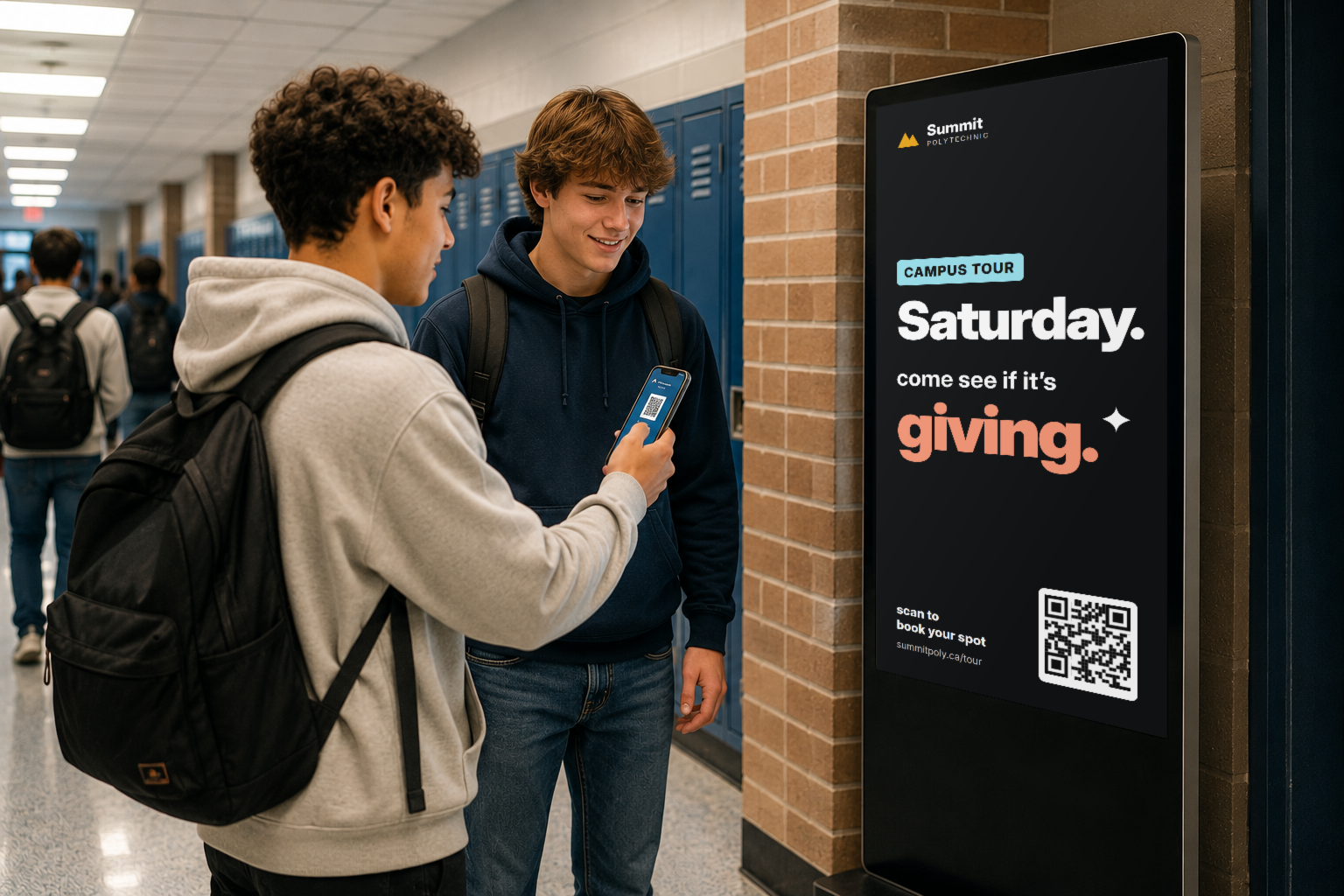
That moment is the whole point. A student saw a program on the way to class, and a week later they're booking time with their counsellor to learn if it’s a real option for them. Nobody had to attend an info session or follow an account for that to happen.
Recognition builds through repetition. Keeping your colours and program imagery consistent across seasonal rotations means students see the same name, again and again, until it feels familiar. We've put together a few more practices for getting value from in-school digital boards here if you’re interested in digging in.
The common thread
Every move on this list comes back to the same idea: show up where students already are, sounding like someone they'd actually want to listen to.
These moves stack. The school a student remembers in Grade 12 is usually the one that kept showing up, in a voice that felt familiar, long before the application opened.
A question worth taking into your next team meeting: where are students seeing you right now, and does it sound like you're in on the joke?
