

Good Creative Doesn't Just Get Seen. It Gets Remembered.
The platforms change. The principles don't. Here's what we keep seeing work across every environment where students spend time.
There's no shortage of advice on how to reach high school students. Most of it focuses on platform tactics: post on TikTok, use Reels, keep it under 10 seconds, lead with a hook.
That advice isn't wrong. It's incomplete. The institutions that earn real recall with high school students aren't just optimizing for individual platforms. They're thinking about creative consistency across every environment where students show up, including the ones that don't have an algorithm.
Here's what we've learned from watching creative perform across both digital channels and in-school screens.
Authenticity isn't a trend. It's a filter.
High school students have grown up inside advertising. They know what a stock photo looks like. They know when a caption was written by a committee. They move past both without thinking about it.
What slows them down is something that feels real. A current student talking about why they chose a specific program. A short clip of what a Tuesday afternoon in a particular department looks like. A face they recognize as someone like them.
This doesn't require a production budget. It requires honesty about what the institution offers and the willingness to let real people say it.
The short window is the whole game
Across every environment where students encounter content, the window is short. On social, a swipe takes less than a second. On an in-school screen, a rotation cycle moves fast and students are rarely standing still.
Creative that works in these conditions leads with the most important thing. Not a logo. Not a brand line. The thing a student would want to know: a scholarship amount, a program name, a deadline, a face.
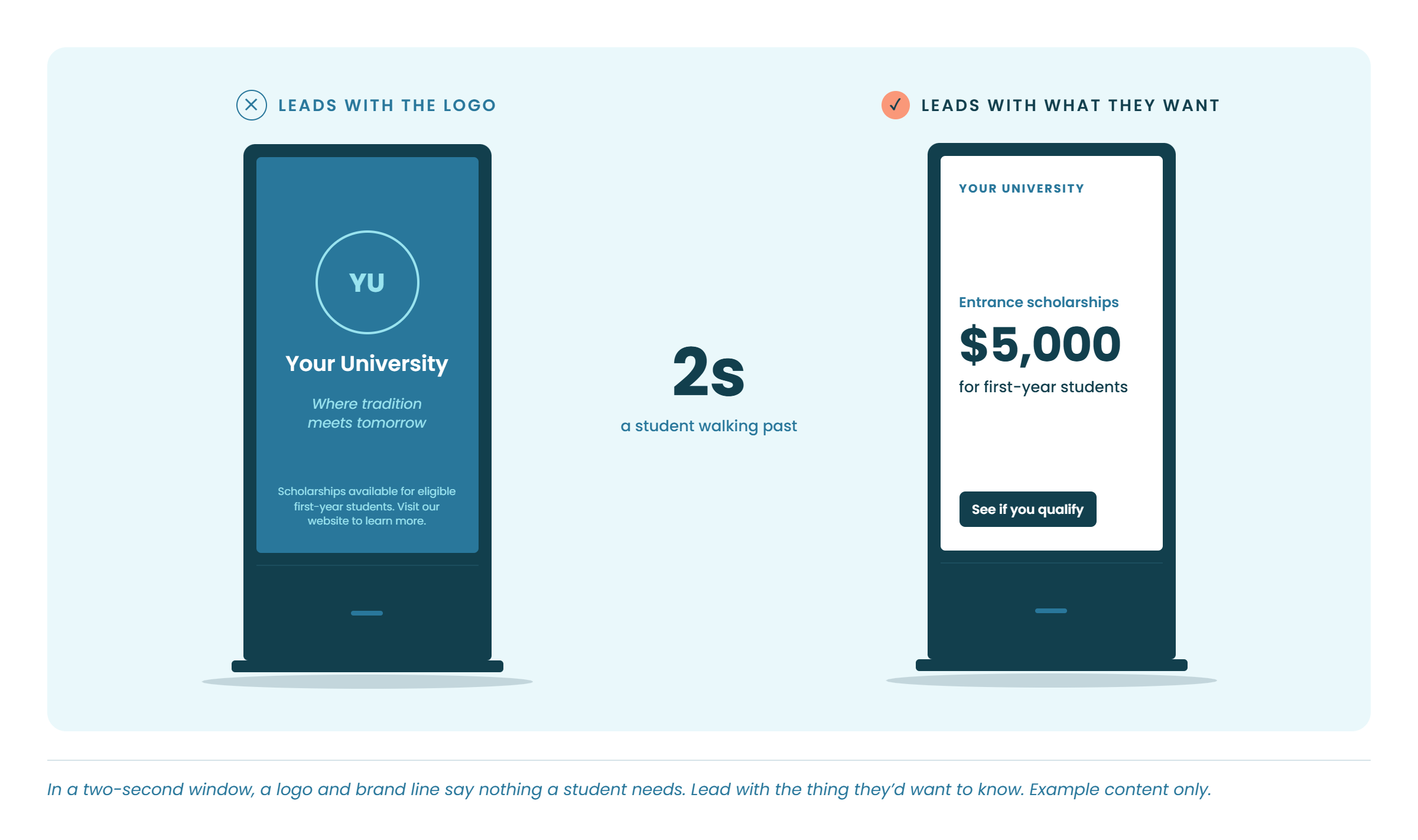
Everything else is secondary. The institutions that treat that as a creative constraint, rather than a limitation to work around, consistently produce content that earns more attention.
Platform fit matters more than platform presence
A 30-second brand film built for a boardroom presentation doesn't work on TikTok. A static poster redesigned as a digital slide doesn't work on an in-school screen. The medium shapes what the message needs to do.
On social, content needs to interrupt. On in-school screens, content needs to belong. Students walk past these screens as part of their daily environment. The creative that earns attention feels like it was built for that hallway, not repurposed from somewhere else.
The institutions that think about creative at the environment level, rather than the platform level, tend to get more out of both.
Consistency across environments is where recall builds
When an institution's creative shows up on a student's phone and in their school building, recognition compounds. It's not about frequency for its own sake. It's about showing up in enough places that the institution starts to feel familiar before a student ever visits a campus or opens an application.
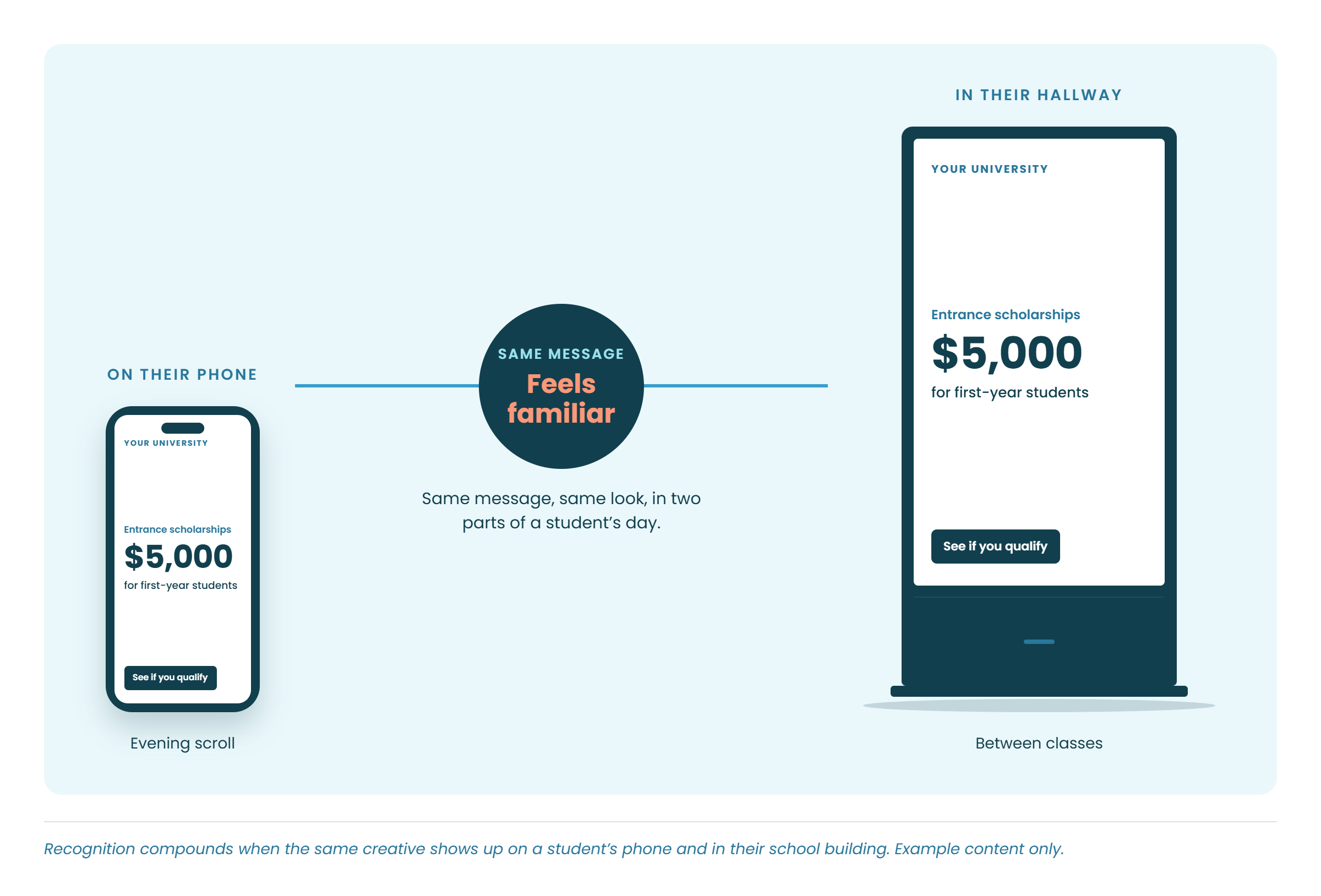
That familiarity is hard to manufacture through any single channel. It builds when the message is consistent, the creative is coherent, and the institution is present in more than one part of a student's day.
In-school screens and digital campaigns aren't competing strategies. For institutions that use both well, they reinforce each other.
The thread that holds across all of it
The patterns that consistently earn attention share one quality regardless of where the content lives: they were built for the environment they're running in. Specific enough to feel relevant. Human enough to feel real. Fast enough to respect the window they're working with.
Maintaining that standard across a full recruitment cycle, across multiple channels and environments, is where the creative challenge gets harder. And it's where the internal case for sustained presence starts to matter as much as the creative itself.