

A shrinking applicant pool will put more pressure on enrollment budgets over the next few admission cycles. Awareness spend is especially exposed because its value rarely fits neatly into the performance metrics leadership uses to review spend. A cut can improve this year’s budget while creating a visibility gap that takes longer to surface.
What The Enrollment Cliff Actually Means for Competition
The number of U.S. high school graduates is projected to peak around 2025 and decline through the rest of the decade, a shift traced back to the drop in birth rates after the 2008 financial crisis. Researcher Nathan Grawe’s demographic modeling puts the decline in traditional college-age population at roughly 15% between 2025 and 2029, with the Northeast and Midwest facing the steepest regional drops.
A smaller applicant pool concentrates competition. More institutions will be recruiting from a shrinking set of students, increasing the value of sustained visibility in the schools that matter most to enrollment. Existing feeder-school presence becomes a position worth protecting.
Why Visibility Spend Gets Reviewed First
Budget lines with a lead count attached survive review with less friction than lines that show up as reach or impressions. Awareness spend gets treated as discretionary because the connection between a display placement in a school and an eventual applicant isn’t a number a spreadsheet can isolate on its own.
Cutting that line looks safe on paper. The institution gives up a position in a market that’s about to get harder to win back.
What Happens When an Institution Leaves a Feeder School
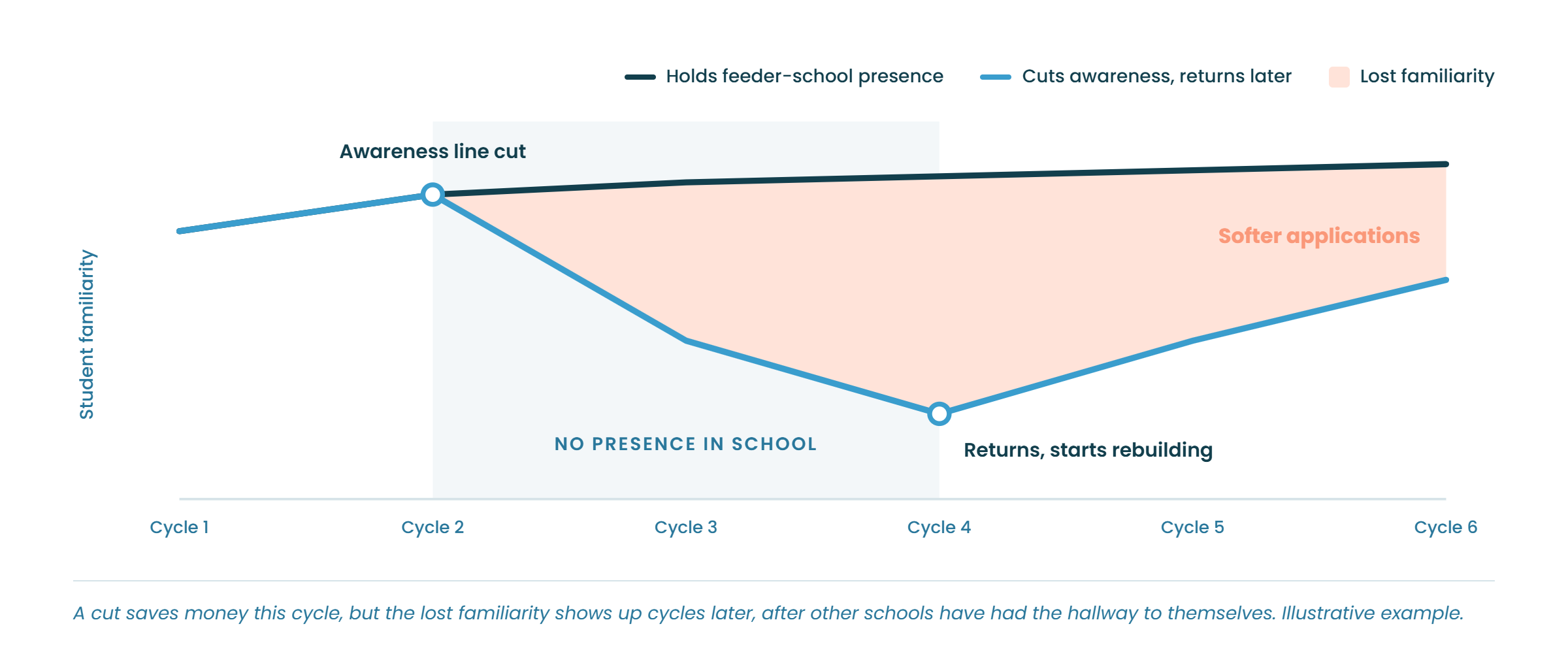
A school hallway isn’t neutral space. When one institution’s presence disappears, students continue to encounter other institutions. Those names have more opportunities to build familiarity while that institution is absent.
Returning to that school later means rebuilding familiarity after a year or more of absence. None of that cost shows up on this year’s budget. It shows up in later admission cycles, when applications from that market start to soften and the cause is harder to isolate.
Treating Visibility As Insurance Changes the Math
Holding a position in a feeder school protects continuity year over year. Rebuilding recognition after leaving and coming back takes time, and the effect of that absence is slower to show up because it looks like a soft application cycle rather than a line item.
That’s the case for treating awareness spend as insurance rather than a discretionary cost: it protects something the institution can’t easily replace once it’s gone, at a moment when replacing it will be more expensive for everyone competing for the same shrinking pool.
What This Means for the Budget Conversation
The strongest defense of an awareness line right now starts with a risk question: what does the institution lose in visibility if this line disappears for a cycle, and what will it take to rebuild that visibility after a year of absence?
That’s a question budget committees already how to weigh. It’s the same logic behind every other line that protects something the institution can’t quickly rebuild once it’s gone.
