

The Students Your Campaign Isn't Reaching
Institutional visibility gaps don't just affect enrollment numbers. They affect which students even see themselves as candidates in the first place.
Every recruitment strategy has a reach assumption built into it. The assumption that students who are a good fit for your institution will encounter it at some point in their decision-making process. That they'll find the website, open the email, attend the information session, or see the ad.
For a significant portion of the students institutions are trying to reach, that assumption doesn't hold.
The visibility gap most recruitment strategies haven’t accounted for
Digital campaigns reach students who are already searching. A student actively researching programs, comparing institutions, visiting websites. These students are findable. They're in market. They respond to the right message at the right moment.
The students harder to reach are the ones who haven't started searching yet. Who don't know which programs align with their interests. Who haven't been told that financial aid could make a particular institution realistic for them. Who won't take the first step toward a counselor or an information session because they don't yet have a reason to.
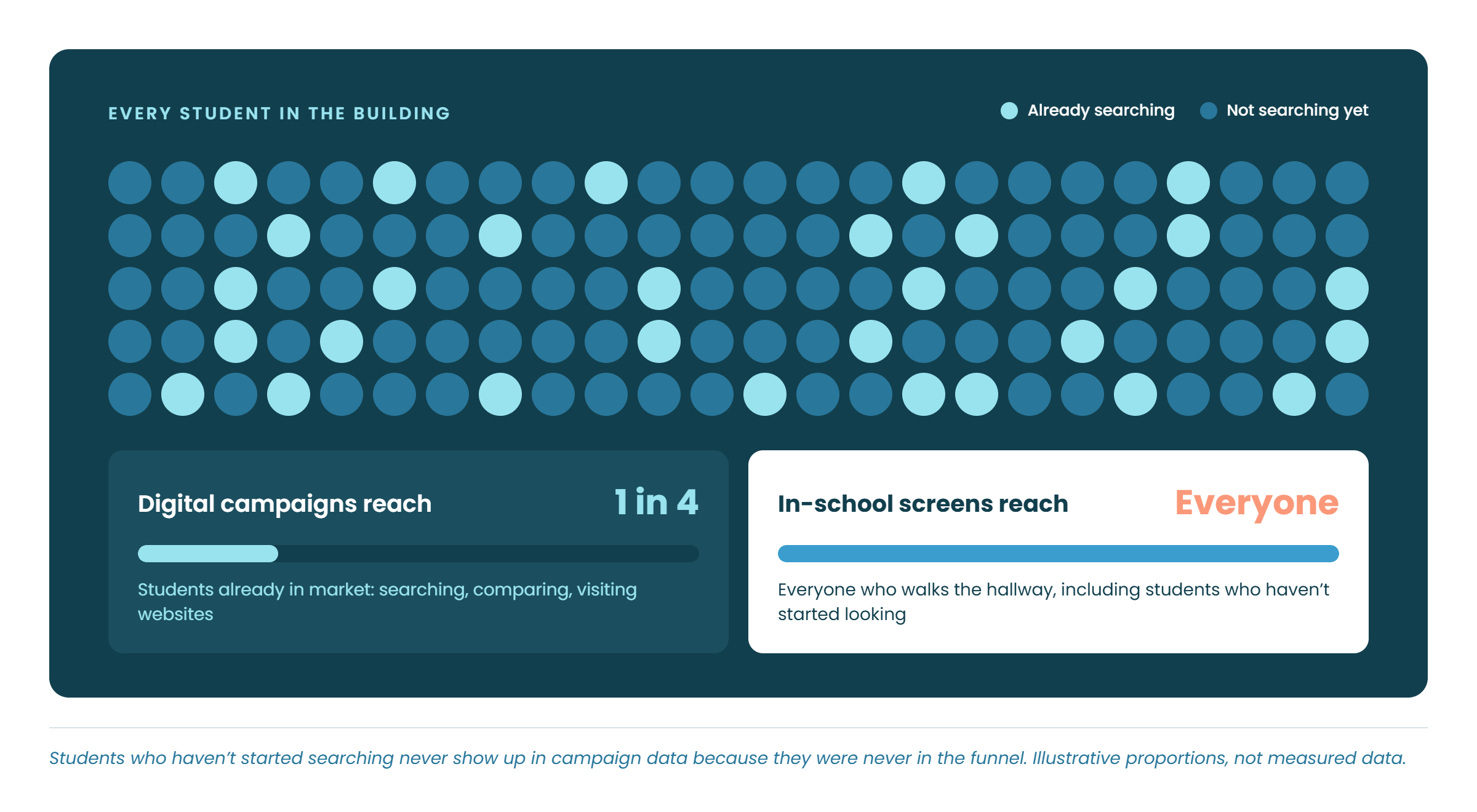
These students don't show up in campaign performance data because they were never in the funnel to begin with. The awareness gap precedes the enrollment gap. By the time an institution notices softening numbers from a particular school or region, the conditions that produced it are often years old.
What passive visibility actually does
There's a meaningful difference between content a student has to find and content that shows up where a student already is.
A website requires intent. An email requires an address and someone willing to open it. A recruitment event requires a student to already know enough to show up.
An in-school screen requires nothing from the student except to be in the building. Which they are, every day.
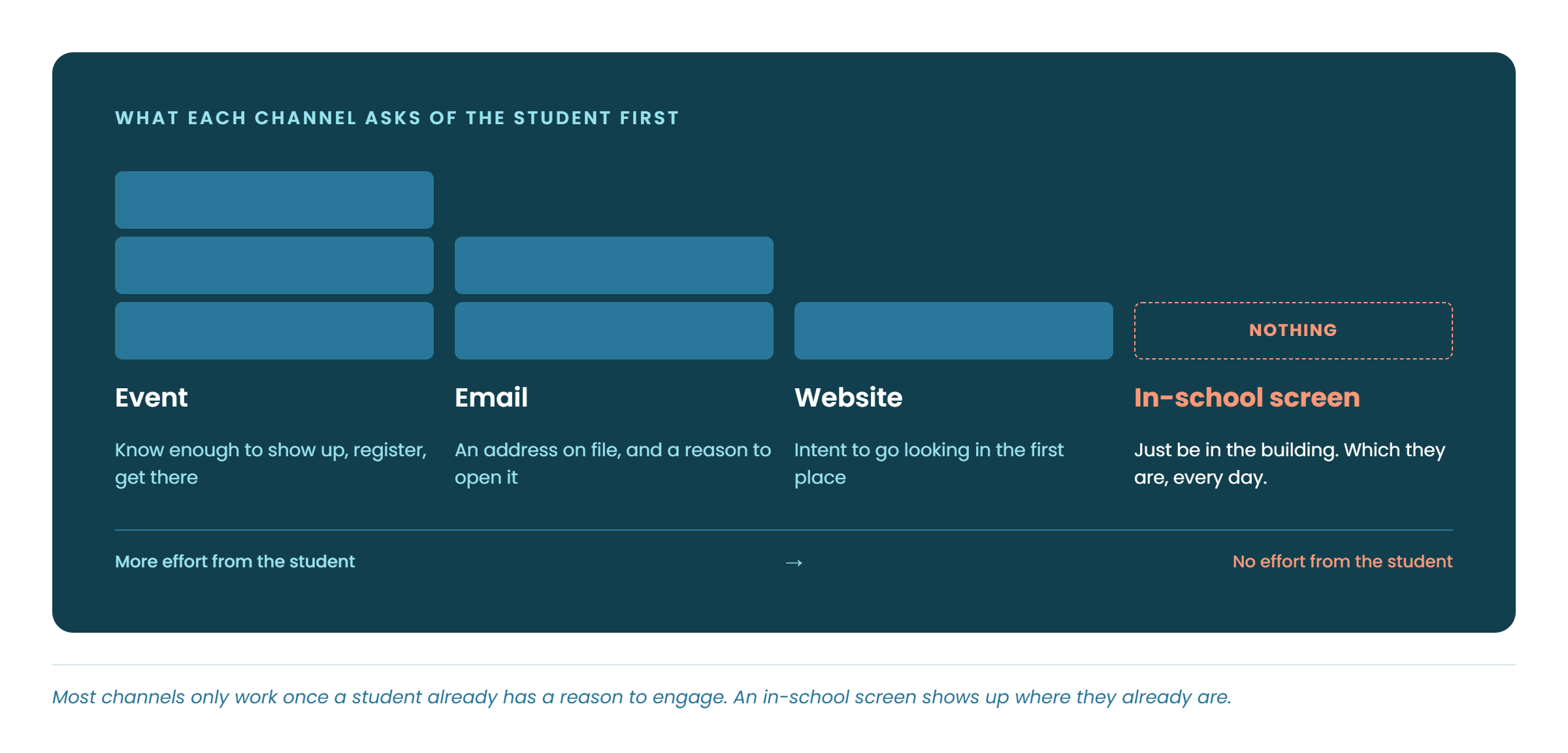
For students who rely on what they encounter rather than what they seek out, in-school visibility is often the first point of contact with an institution they hadn't considered. A scholarship amount that feels attainable. A program name that connects to something they care about.
None of that moves a student to a decision on the spot. But it plants something. And for students who weren't going to find the opportunity on their own, that's where the whole conversation starts.
Why this matters for how institutions think about presence
Recruitment strategies built entirely around findable students will always have a ceiling. The students already searching will find multiple institutions. They'll compare and they'll choose. The institutions with the strongest digital presence will compete for them effectively.
The students who weren't searching represent a different kind of opportunity. Reaching them requires showing up in the places they already occupy, consistently enough that something sticks before the decision window opens.
In-school presence does something a campaign alone can't. It's there before a student knows to go looking.
The compounding effect of consistent visibility
An awareness gap inside a feeder school doesn't produce an immediate enrollment impact. It produces one two or three recruiting cycles later, when a cohort of students who never developed familiarity with an institution simply doesn't consider it. They never encountered it enough to form an opinion.
Closing that gap requires presence that runs continuously, not a campaign that activates during recruitment season and goes dark in between. The institutions that treat in-school visibility as infrastructure rather than a seasonal tactic are the ones building familiarity that holds through a full admissions cycle and compounds across years.
The students who benefit most from that consistency are the ones who needed someone to show up before they knew to go looking.
That's the case for structural presence. The students who see something that changes what they think is possible for them.