

By the Time They're in Your CRM, the Decision Was Already Made [Part 3 of 3]
Part 2 of this series was written for marketing. This one is for admissions and enrollment leaders, and the same reality lands differently from where you sit.
Here's the plain-terms version before we get into what it means for your funnel.
In May 2026, Google made AI Mode the dominant search experience globally. Students searching for colleges now get an AI-generated answer naming a few institutions, not a page of links to explore. And this summer, Google is rolling out background information agents: tools a student configures once, that then run continuously against their criteria across the entire web for 6 to 18 months before they apply.
In enrollment terms: a student's consideration set now forms further upstream than anything you can track or influence through traditional recruitment tactics. By the time they're a name in your CRM, the decision about whether to consider your institution was already made somewhere you couldn't see.
You Already Have a Word for This Problem
Stealth applicants. Students who appear in your pool with no trackable prior engagement: no visit, no hand raised anywhere you could see. They show up at the application.
AI search changes the conditions that produce them, and it changes them at scale. Students now build their entire consideration set inside an AI interface, over months, without a single outward signal you can capture. By the time that student is a lead you can email or an applicant you can count, the decision about whether your institution made their list was already made in a process you had no visibility into.
Earlier in 2026, EAB published a survey of over 5,000 high school students that revealed 46% of students now use AI in their college search, up from 26% the prior spring. That figure was taken even before Google made AI the default. The students now entering your junior-year recruitment window are the first cohort to build their college lists entirely inside an AI-default environment.
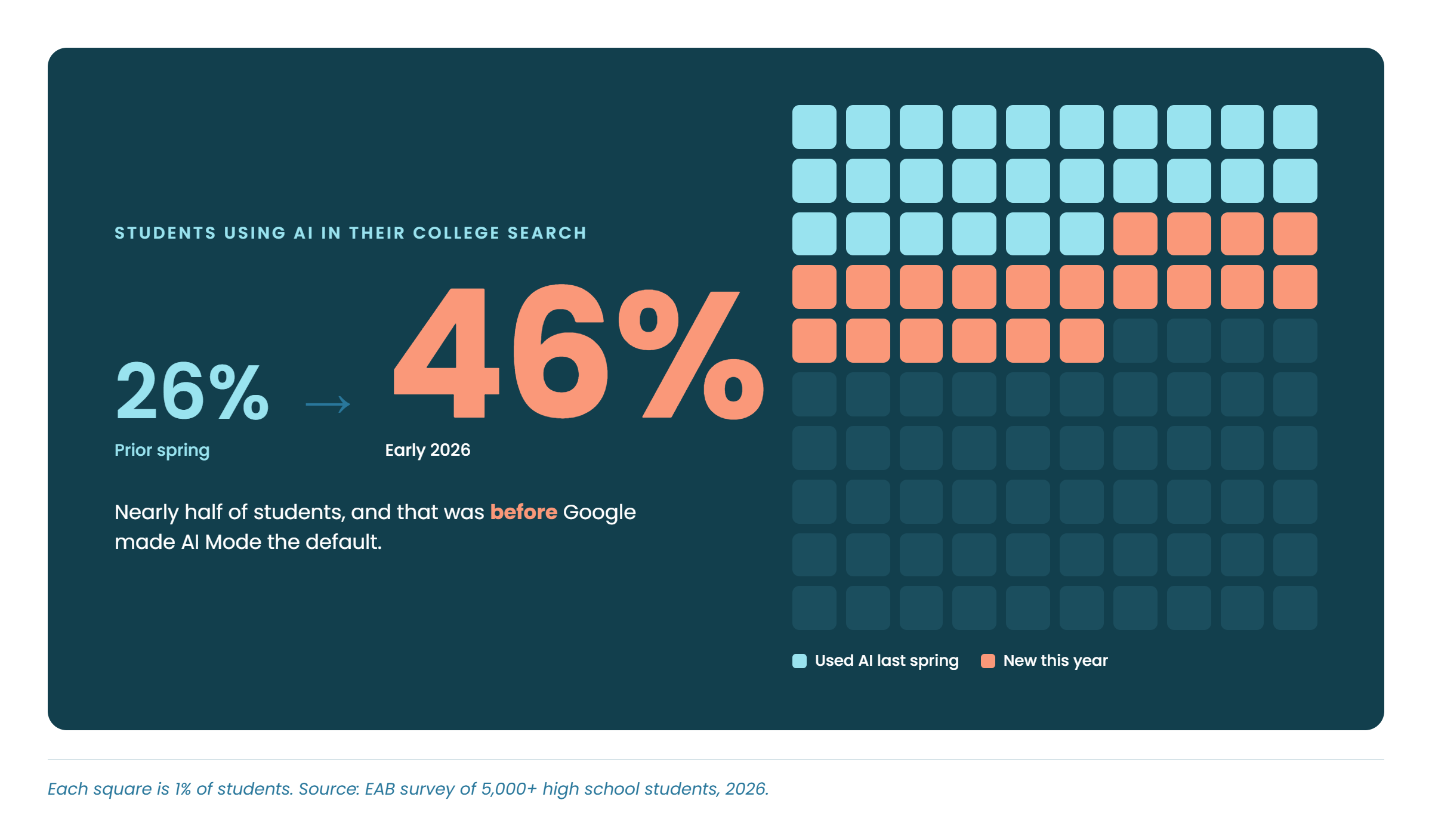
The top of the funnel moved upstream, out of view.
The Funnel Stage No Tool in Your Stack Can Touch
Enrollment management runs on the funnel: applications, admits, deposits, enrolled. Every tool in your stack moves students through those stages. The assumption underneath all of it is that the students at the top of your funnel are already considering you.
That assumption still holds. What changed is when and how consideration forms.
A student's list now assembles in a background process, shaped by what was already said about your institution, which names came up in trusted conversations, and what felt familiar when options surfaced. By the time they enter your funnel, that part already happened. And if your institution wasn't present in their world when it did, spend in the stages below can't recover that ground.
Here's what that means practically. Eduventures found 86% of college-bound students cite at least 1 influential individual as shaping their consideration set: parents, peers, teachers, counselors. The trusted adults doing that work are in high school hallways and guidance offices every day, long before any search session starts. A school counselor who recognizes your institution's name from the screen in their hallway is more likely to mention it when a student asks about options.
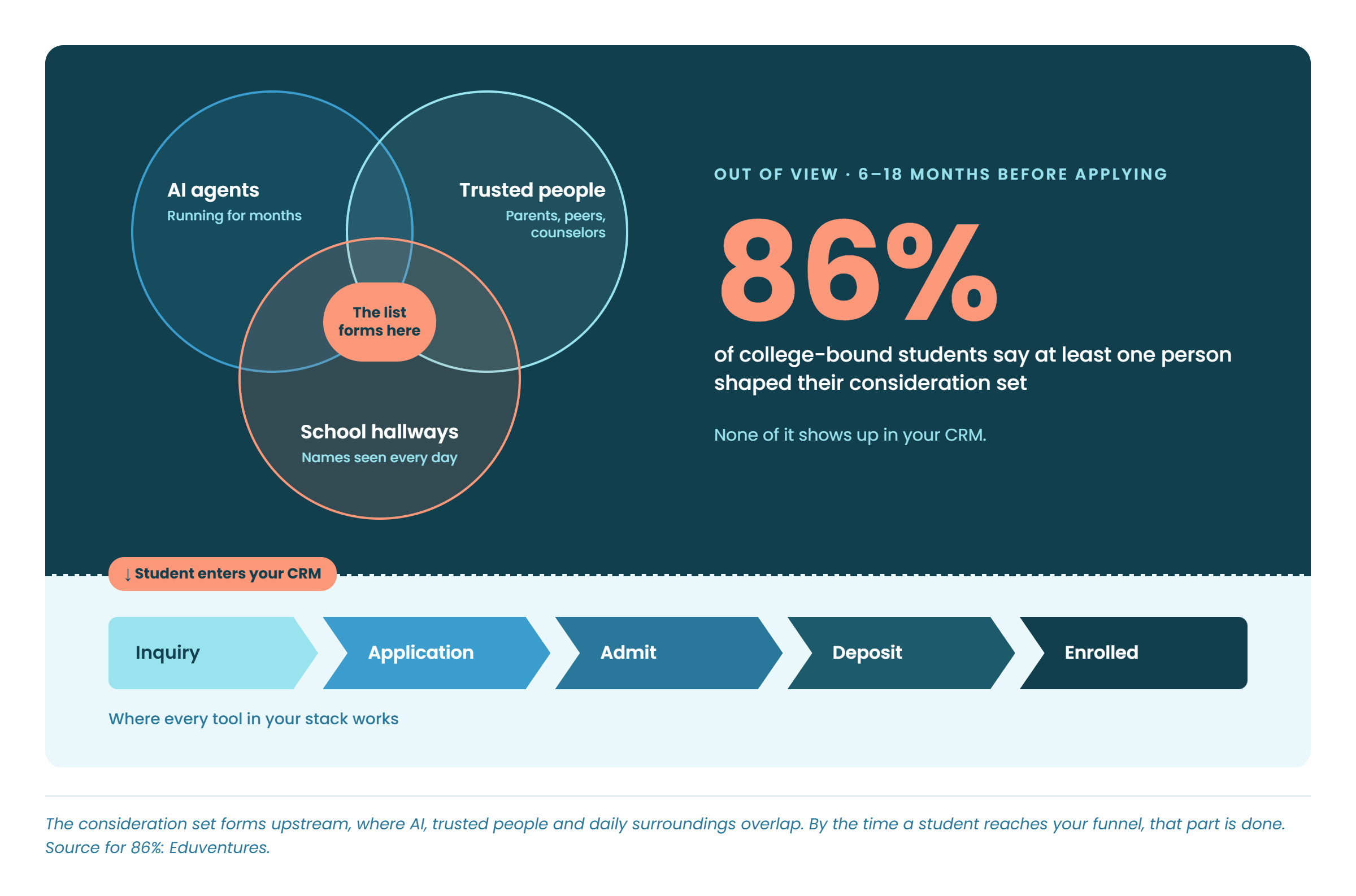
That mention shapes a list. And a student who already knows your name deposits more confidently and melts less. Familiarity gets you into consideration, and it holds you through yield.
How to Have This Conversation With Your Marketing Team
The instinct in enrollment is to ask for attribution. If an investment can't be tied to applications or yield, it's hard to defend. That's reasonable, and it's also the wrong frame for this problem.
Presence in the high schools where your prospective students spend their days builds something that performance marketing operates inside of. "It puts your name in the set students consider when AI surfaces options and when counselors have the conversation about what comes next. Search, retargeting, email sequences: those tactics compete to win within that set. Awareness determines whether you're in the competition at all.
When the conversation turns to 'how many more applications does this get us,' the answer is this: we don't claim to move your application count. We make sure you're in the set students will even consider, which is the one thing no funnel tactic can recover once it's gone. That's risk management. Hold that framing even when pushed.
What Gets Built Upstream of Your Funnel
OnDeck puts your brand inside the high schools where your prospective students spend their time, every day, for years. The in-school screen is the highest-dwell, most repeated touchpoint a 16-year-old has outside their own home. It builds the familiarity that shapes consideration long before any AI session begins or any application opens.
Combined with programmatic display, connected TV, and social, it extends that presence across every surface a student occupies: where they learn, where they walk, and where they scroll.
The question worth bringing to your next planning conversation: by the time a student is in our CRM, the decision about whether to consider us was already made somewhere we couldn't see. What are we doing upstream of that?
Also in this series · Part 1: Google Just Rewrote the Rules. Here's What That Means for Higher Ed. The structural shift in search, what Google announced, and why familiarity is the real filter.
Part 2: You've Been Right About Awareness All Along. Here's Your Proof. For higher ed marketers: the OOH data, the familiarity mechanics, and how to defend awareness spend in any room.
