

Why the ROI Question Misses the Point of Awareness Investment
The question isn't going away. Here's how to answer it without undermining the investment.
At some point, someone in your organization is going to ask what your awareness campaigns are producing.
It might be a VP during budget season, or a CFO who just pulled the marketing line and wants to understand it before approving the next cycle. The instinct is to reach for metrics. Impressions delivered. Clicks generated. CTR benchmarks.
Those numbers aren't wrong. They're just not built to answer the question being asked. When you use performance metrics to defend awareness spend, you invite a performance conversation. That's a conversation awareness investment wasn't designed to win.
Here's a more useful frame.
Awareness doesn't convert. It compounds.
The student who submits an application in November didn't make that decision in November. They made it over months of small exposures: a name they recognized, a program they remembered, an institution that felt familiar when they finally started comparing options.
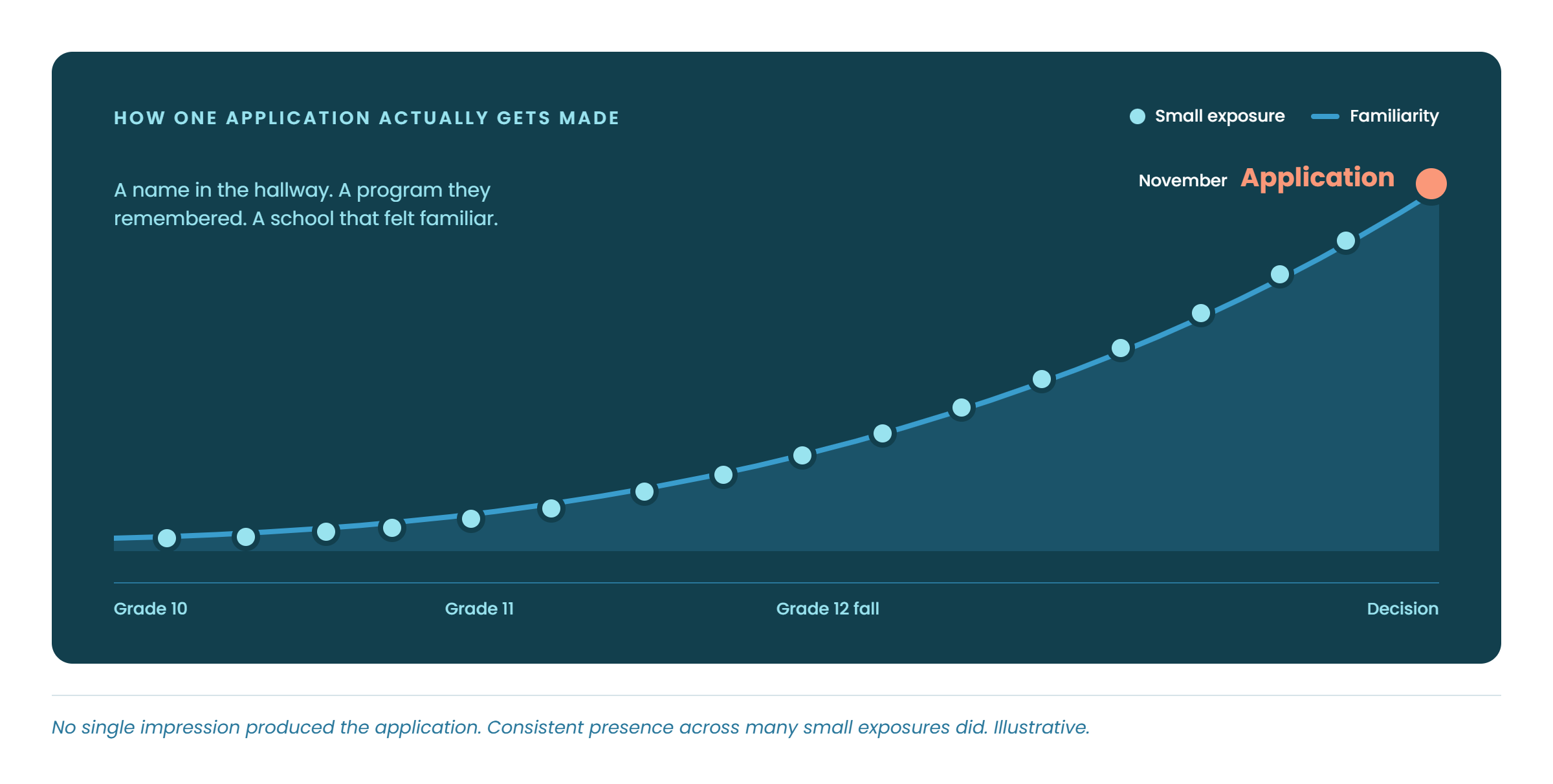
No single impression produced that outcome. No single campaign can claim credit for it. What produced it was consistent presence across enough touchpoints that the institution became part of how that student thought about their future.
That's how awareness works. The institutions that understand this stop trying to draw a straight line from campaign spend to applications. They start asking a different question: are we present enough, in enough of the right places, that students know who we are before they start deciding?
The enrollment risk that builds slowly
Enrollment doesn't drop overnight. The conditions that produce a weak applicant pool develop over years, and awareness gaps are one of the primary contributors.
When an institution pulls back on visibility inside feeder schools, the effect isn't immediate. It shows up two or three recruiting cycles later, when a cohort of students who never developed familiarity with the institution simply doesn't consider it. They didn't reject it. They never encountered it enough to form an opinion.
That's the risk awareness spend is protecting against. The slow erosion of familiarity in the schools that matter most to your pipeline.
What to measure instead
This doesn't mean awareness investment is unaccountable. It means the right signals look different from performance metrics.
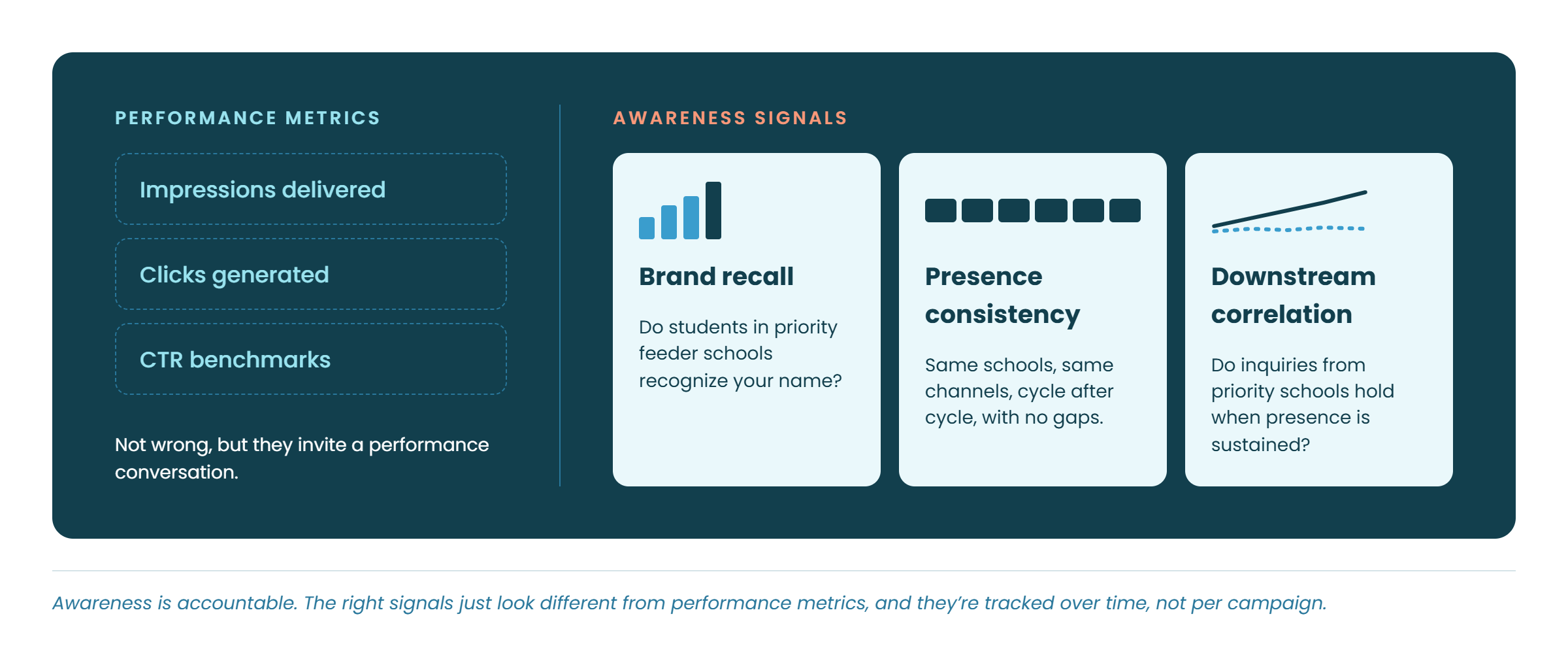
Brand recall is worth tracking. Do students in your priority feeder schools recognize your institution's name, programs, or visual identity? That's measurable, and it connects meaningfully to downstream enrollment behavior.
Presence consistency is another signal worth watching. Are you showing up in the same schools, across the same channels, through the same recruitment cycle, year over year? Consistency builds familiarity. Gaps erode it.
Downstream correlation tells a more honest story than any single campaign report. When awareness investment is sustained, do inquiry and application numbers from priority schools hold or grow? When it's pulled, do they soften? That pattern, tracked over time, is the data worth having.
The internal conversation worth having
When someone asks what your awareness campaigns are producing, the most useful answer isn't a metric. It's a reframe.
Awareness spend is protecting pipeline. It's ensuring that when students in your priority feeder schools start forming opinions about where to apply, your institution is already part of the conversation.
The question worth sitting with isn't what did this campaign generate. It's what does our visibility in these schools look like if we stop showing up.
Answer that one honestly, and the budget conversation tends to land somewhere more productive.
Defending the investment is one thing. Maintaining the creative output that sustains it across a full recruitment cycle is a different challenge entirely. That's where most institutions feel the operational pressure most acutely.