

Brand Is Future Demand. Timing Is Everything.
Everyone in higher ed marketing seems to agree on brand right now. EAB's CMO Lia Davidson made the case earlier this month that brand is future demand, and she landed on a line worth borrowing (she says it herself: put this in your next slide deck!): "You can't convert demand that doesn't exist."
Agreed. Now the harder question: when do students form that first impression of your school, and where?
The shortlist gets built before the search bar
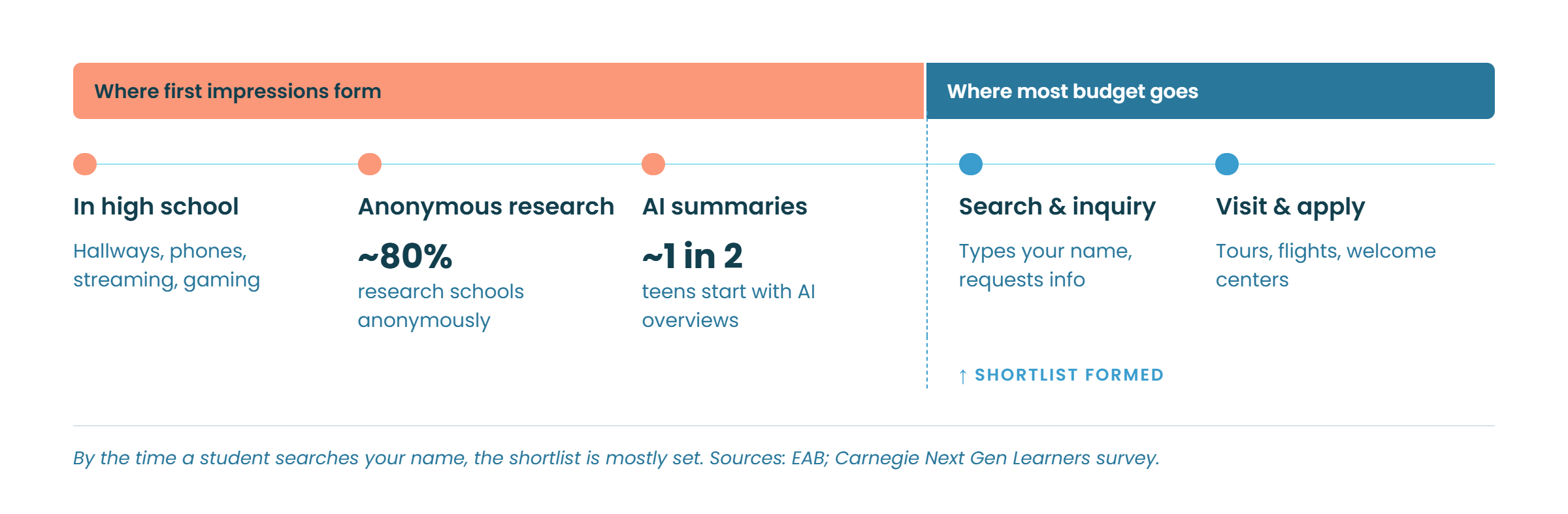
Students make up their minds earlier and more privately than most enrollment plans assume. Davidson points out that roughly 80% of Gen Z and Millennial students research schools anonymously, sometimes talked about as “the dark funnel”, until late in their journey. If your brand doesn't show up during that stretch, your conversion campaigns have nobody to convert.
AI is speeding that up. Carnegie's Next Gen Learners survey of more than 3,300 students found nearly half of U.S. teens go first to AI-generated summaries when exploring colleges. And according to Carnegie's Jon Covell recent piece in Inside Higher Ed, those overviews are often shaping perceptions before students click through to a school's website.
EAB's own student survey found 46% of students now use AI tools during their college search, up from 26% in spring 2025, and 18% removed a college from consideration based on what AI surfaced.
So by the time a student types your name into anything, a big chunk of the decision about whether you're worth a look has already happened.
Meanwhile, the money's at the bottom of the funnel
Look at where schools are spending. Inside Higher Ed reported this week that colleges are overhauling campus tours with branded shuttles, free flights and hotel rooms, and multimillion-dollar welcome centers.
Fair enough. Visits convert. But every dollar of that only works on a student who already knows the school exists and likes it enough to show up.
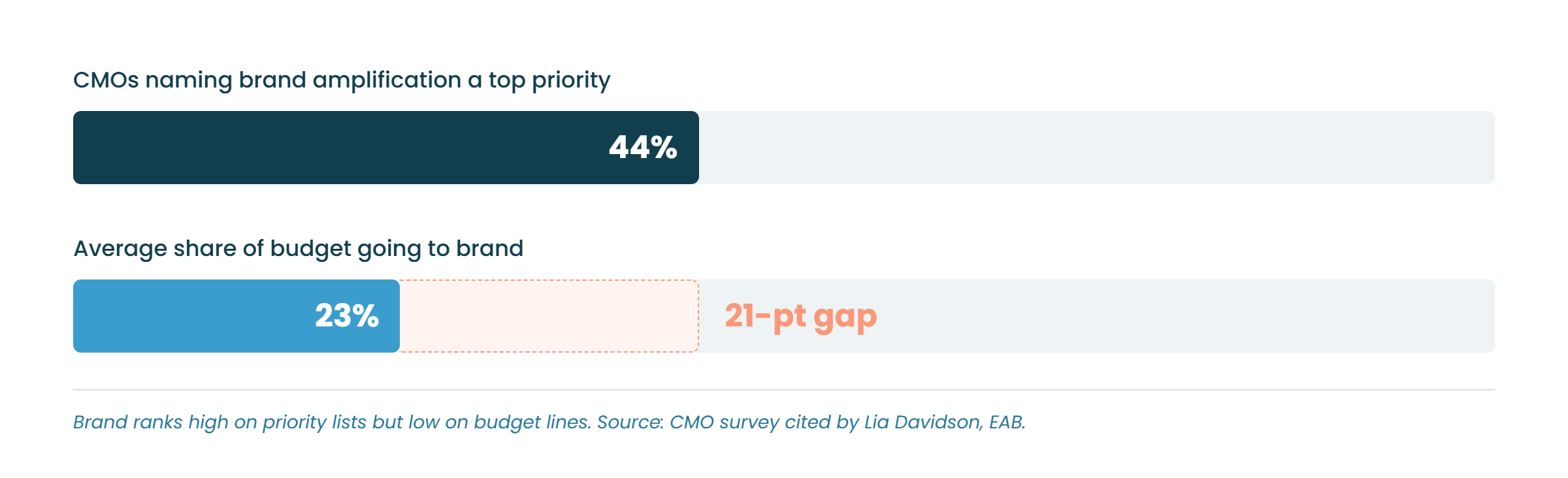
And budgets aren't growing to cover both ends. In EAB's research, 65% of higher ed marketing leaders said they're facing higher goals with flat or shrinking staffs and budgets. The CMOs Davidson surveyed put 23% of budget toward brand on average, while 44% named brand amplification a top priority. That gap is where a lot of future enrollment goes missing.
The window is earlier than you think
If awareness budgets are tight, timing matters more than volume. The best time to reach a prospective student is before they start searching, while they're still in high school and forming impressions without realizing it.
That's where pre-search familiarity comes in. Students spend their days in school hallways, on their phones, streaming, and gaming. Showing up there through in-school digital screens and channels like paid social, CTV, and Twitch puts your name in their heads before any search, chatbot, or college fair asks them to make a list.
Then, when a student eventually asks ChatGPT for schools with a good nursing program, or scrolls past your ad, or gets a nurture email, your name already means something.
Yes, it's harder to measure. Do it anyway.
The attribution problem is real. Even Covell acknowledges that students who form first impressions in AI conversations often reach a school later through other channels that are difficult to trace back. The same goes for any awareness work.
That doesn't make it unmeasurable. Davidson suggests tracking leading indicators like branded search volume and share of voice in AI search, plus application lift in markets where brand campaigns run. Set those expectations upfront, and awareness stops looking like a mystery line item.
Familiarity is the gate, not the game
Fit still wins the final decision. Your campus tour, your website, and your financial aid clarity all matter enormously once a student is paying attention.
Familiarity gets you onto the list in the first place. Skip that step and the rest of the funnel has nothing to work with.
