

5 Takeaways from The Awareness Gap: What the AI Search Shift Means for Enrollment Visibility
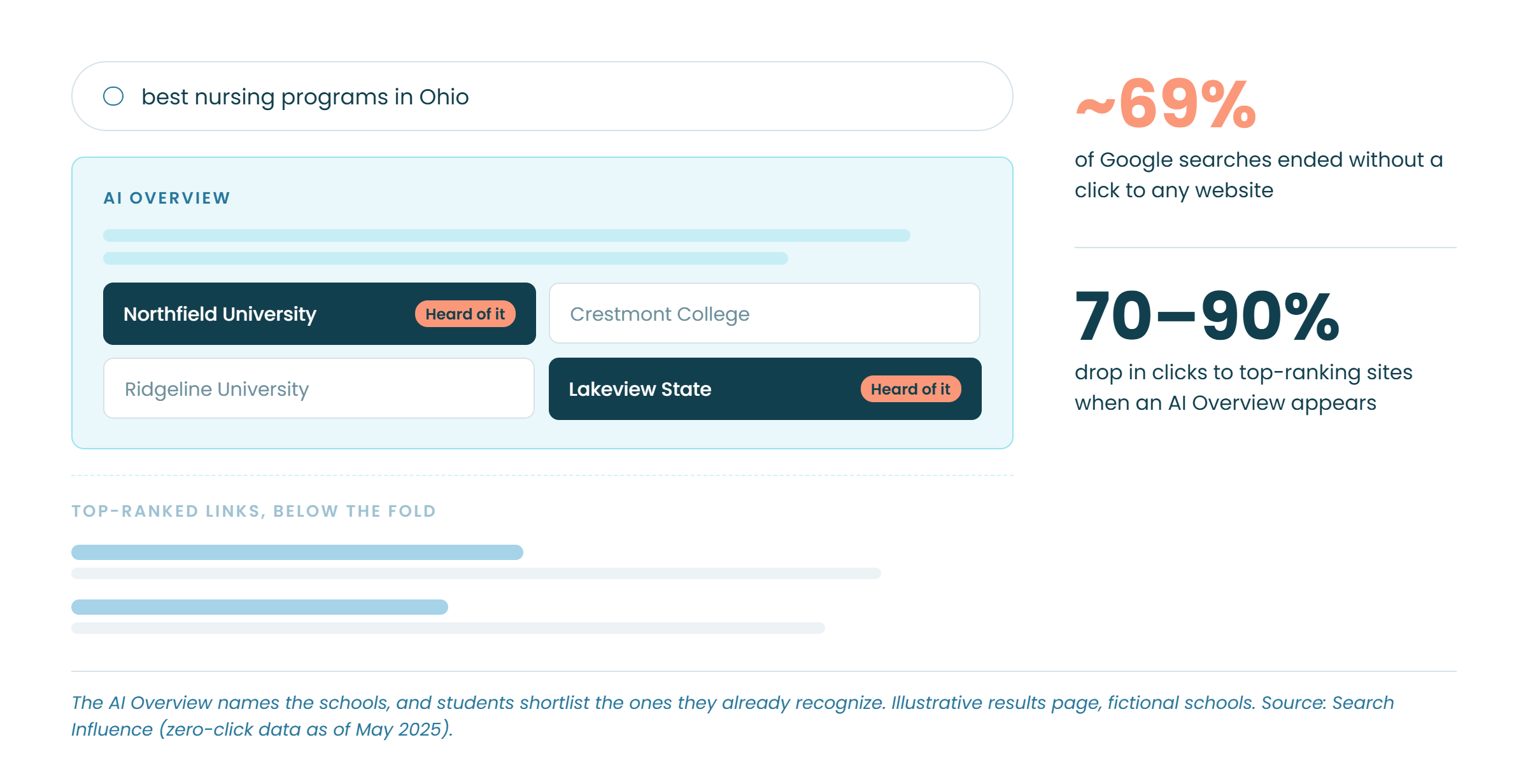
Picture a junior at a high school outside Columbus. She types "best nursing programs in Ohio" into Google. Before she scrolls an inch, an AI Overview at the top of the page hands her 4 names. The links she'd have clicked a few years ago sit somewhere below the fold. She's heard of 2 of those schools. Guess which 2 make her list.
That moment sat at the center of our September 29 webinar, The Awareness Gap. Google still sits at the heart of how students search. What changed is what they see first, and OnDeck’s John Reid walked through what that shift means for enrollment visibility. Every thread led back to an idea OnDeck has built its work around from the start: familiarity is the filter.
Here are the 5 ideas we'd want every enrollment leader to carry into their next planning meeting.
1. The list gets written early
A student's college list starts forming in 9th and 10th grade hallways, long before senior year. When Niche surveyed high school juniors about their college search, 72% said they started actively researching colleges as freshmen or sophomores.
So by the time a grade 12 student types a question into Google, they already carry a short list of names in their head. The schools that showed up in those earlier years walk into every search with a head start.
2. Google answers the question before anyone clicks
For years, the goal was ranking on page 1. Now Google’s AI Overviews answer the user’s question directly at the top of the page, and the student reads the answer and moves on. Search Influence reports that click-through to top-ranking websites drops 70–90% when an AI Overview appears, and that roughly 69% of Google searches ended without a click to any website as of May 2025.
That changes the job. A top ranking still holds some weight, but ensuring your name gets returned inside the overview matters more. And that’s only the first half of the battle. When your school does appear in that summary, the student needs to recognize it on sight. If they don’t, they may as well have not seen it at all.
3. Recognition pays off on the results page
Everspring's 2026 AI Search Trends Brief found that branded search volume fell across every institution type it studied, with the steepest drops at private and regional schools. Fewer students type a college's name. More of them type an outcome question and let Google's AI answer it.
Brand recognition still wins clicks when a student does search by name. An aggregated analysis from Neil Patel found that branded queries with AI Overviews saw an 18.7% increase in click-through, the only category in the dataset that gained.
Decision science explains why. Goldstein and Gigerenzer's recognition heuristic describes how people choosing between a familiar option and an unfamiliar one tend to treat the familiar one as the better choice (The Behavioral Scientist). Familiarity grows through repeated, ordinary encounters: the screen a student walks past twice a day, the Friday night game, the counselor who mentions you by name. When a student sees your name in a hallway all year, it reads like an old friend when it shows up in an AI Overview.
4. Consistency turns recognition into visibility
Belmont University gave us a great example of how small the fix sometimes is. In an Inside Higher Ed report from February 2026, Belmont's marketing team traced part of its AI visibility gap to materials that switch between "Christian" and "Christ-centered," which lowers the odds of surfacing when a student searches with only 1 of those terms.
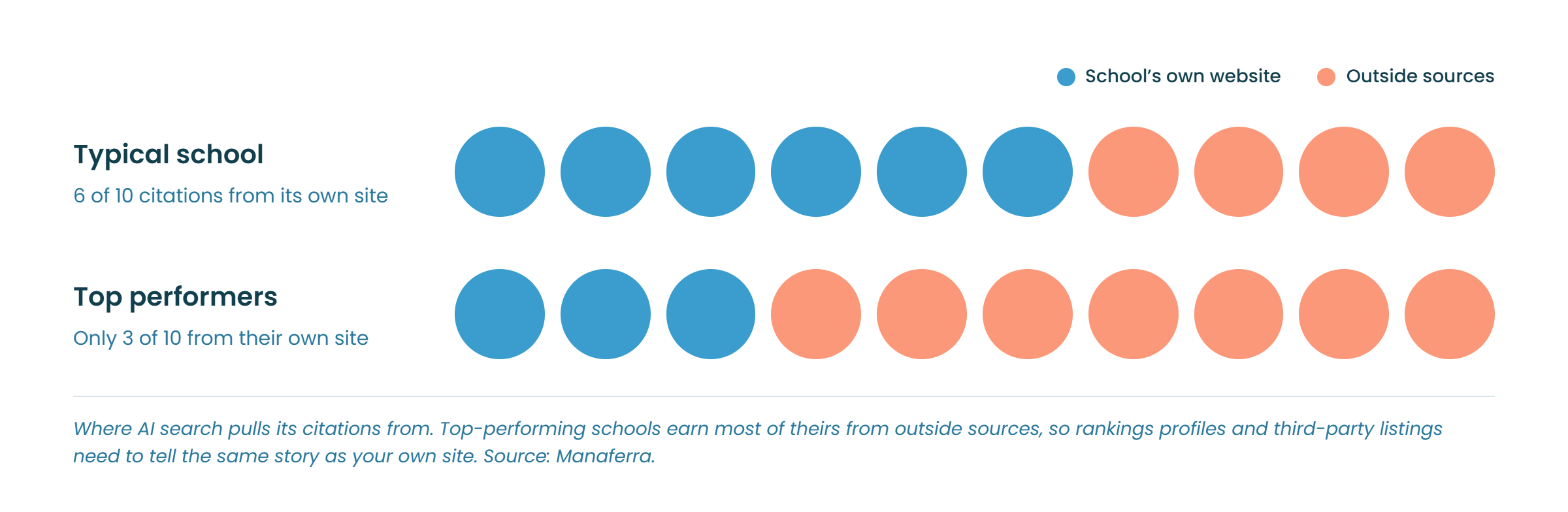
Outside sources shape the answer too. Manaferra found that a typical school draws 6 of every 10 AI citations from its own website, while top performers draw only 3 of 10 from their own domain. Take an afternoon this quarter to read your program pages, rankings profiles, and third-party listings side by side, and make sure they all tell the same story.
5. Build awareness first, then amplify
Nobody on a marketing team has spare hours right now. EAB's survey of 121 marketing leaders found that 65% face higher goals with flat or shrinking staff and budgets. Paid search keeps getting pricier too: Everspring reports a 45% year-over-year jump in average cost-per-click on higher ed terms (via Search Influence).
That pressure makes sequence matter. Build familiarity in your priority feeder regions first, then put performance marketing behind it. Paid campaigns convert faster and cost less per student when students already recognize the name in the ad, so every dollar you spend after laying that foundation works harder.
Where to go from here
Nobody has AI search fully mapped yet, including us. Google keeps changing what shows up at the top of the page, and every enrollment team we talk to is testing, learning, and comparing notes as they go. That shared curiosity came through in every question from the chat on September 29.
What gets us excited is how much opportunity sits inside this shift. Students still build their lists early, and they still gravitate toward the names they know. The institutions that show up in the places students spend their day, year after year, have a real chance to stand out while everyone else is still sorting out what changed. We're looking forward to learning alongside you.
Missed us live? [Watch the full webinar recording here](ADD RECORDING LINK). John walks through all 5 takeaways in more depth, plus the Q&A from the session.
