

Your OnDeck screens put your college in front of students every school day. Then winter break starts, hallways empty out for 2 weeks, and students spend that time at home with their families in front of a TV.
Streaming TV (also called CTV, or connected TV) lets you run the same message, in the same regions, on the screen they watch over the holidays. Here's what the 2025 and 2026 data says about that window, and how to make the case for it inside your institution.
Winter break is the biggest streaming window of the year
On Christmas Day 2025, US viewers streamed 55.1 billion minutes of TV, the largest single streaming day Nielsen has on record. Streaming made up 54% of all TV usage that day. The previous record, 51.2 billion minutes, was set on Christmas Day 2024.
The whole month followed the same pattern. Streaming captured 47.5% of US TV viewing in December 2025, a monthly record at the time. On Saturday, December 13, it passed 50% of all TV for the day.
That peak lands in the same 2 weeks your hallway screens go without a student audience. Families are home, together, and watching.
Streaming is now how most households watch TV, in the US and Canada
The holiday peak sits on top of a year-round shift in viewing.
In July 2026, streaming accounted for 49.0% of US TV viewing, more than broadcast (19.5%) and cable (18.7%) combined, according to Nielsen's The Gauge as reported by Adwave.
Canada is on the same path. 48.5% of Canadian households now have no traditional TV subscription, according to Convergence Research's Couch Potato Report, as covered by iPhone in Canada. About 27 million Canadians stream TV, up 35% over 5 years, per a June 2026 Roku and Fuse Insights study of 2,043 Canadian adults.
Ads are part of that viewing. The same Roku study found 84% of Canadian streamers watch ad-supported TV every month, averaging 13 hours a week. That's half of all their TV time.
A CTV ad plays in full, on the largest screen in the house
CTV ads averaged an 88.57% completion rate in Q4 2025, based on Peer39's Q4 2025 benchmarks for campaigns with 100,000+ impressions. In the same data set, 84.85% of CTV ad starts happened on a TV screen, with mobile phones at 1.15%.
For an awareness message, those 2 numbers matter together. Your full spot runs on a shared screen in the living room, where a student and a parent can both see it.
Parents carry the most influence and get the least contact
Spark451's 2026 survey of more than 3,500 college-bound students and parents found 74% of parents received direct communication from colleges this year, down from 85% in 2025. Among the 26% who heard nothing, 72% said they would have wanted to.
The same release describes parents as "far and away the most influential voice in the enrollment decision-making process."
Your hallway screens reach students during the school day. CTV reaches the household, which puts your name in front of the parent who helps decide which schools make the list.
Most students stay anonymous, so familiarity has to come first
About 61% of students in the Spark451 survey never submitted an inquiry or form to a college. Of the 39% who did, more than half did so only because it was required.
That limits what performance channels can do in a high school. Inquiry-based programs only see the students who identify themselves, and most students don't. You can't performance-market your way into a hallway.
Students still research on their own terms. In the same survey, 56% used a college website and 45% used generative AI tools during their search. A student can only look up a college they already know about. Familiarity is what gets your school onto that list.
When a college drops out of a student's daily view, the effect doesn't show up right away. Awareness gaps compound over a cycle and surface later as a thinner applicant pool, when they're harder to close.
How hallway screens and CTV work together
OnDeck's network covers 750+ schools across North America, reaching 500K+ students and generating 1M+ impressions every day. A CTV flight targets the regions around your priority schools and runs the creative students already know from the hallway.
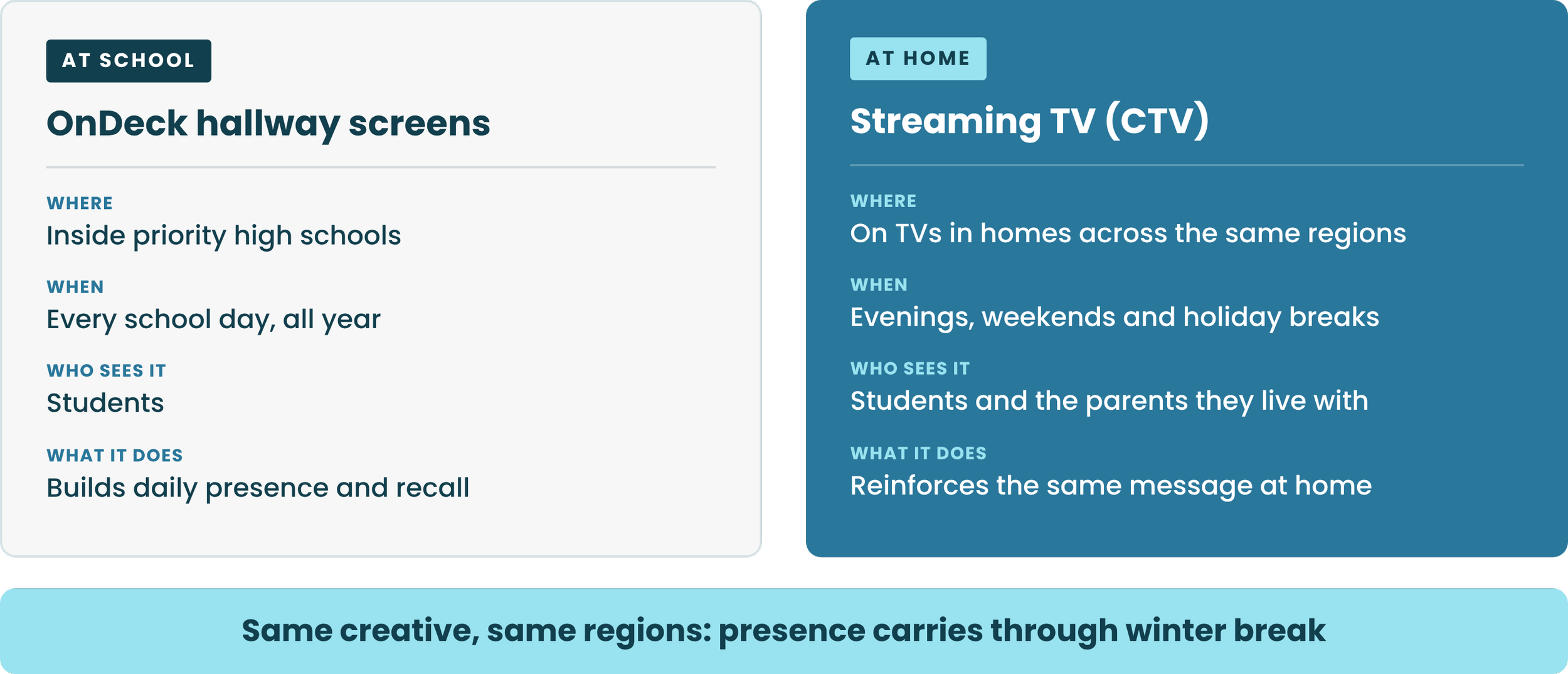
Holding presence through the break keeps your college familiar when students come back in January and the next round of conversations about where to apply begins.
Making the case to your budget holder
A holiday CTV flight is short and timed to the highest-viewing days of the year. It extends a program you already run, with creative you already have, and it reaches the parents your current outreach may be missing.
Report it in awareness terms: reach, impressions, completion rate and frequency in your target regions. Branded search and direct site traffic from those regions are useful downstream signals to watch alongside them.
If you'd like to see what a holiday flight looks like for your schools, your OnDeck account manager can build a package from your current screen creative to show you!
