

If you recruit in the Eastern U.S., the best student recruitment service is the one that puts your name in front of students in your priority high schools before they start building a college list. Most services in the category start working later than that.
Here's how the Eastern market is shifting, what most recruitment services cover, and what to ask any partner before you sign.
Why is student recruitment in the Eastern U.S. different?
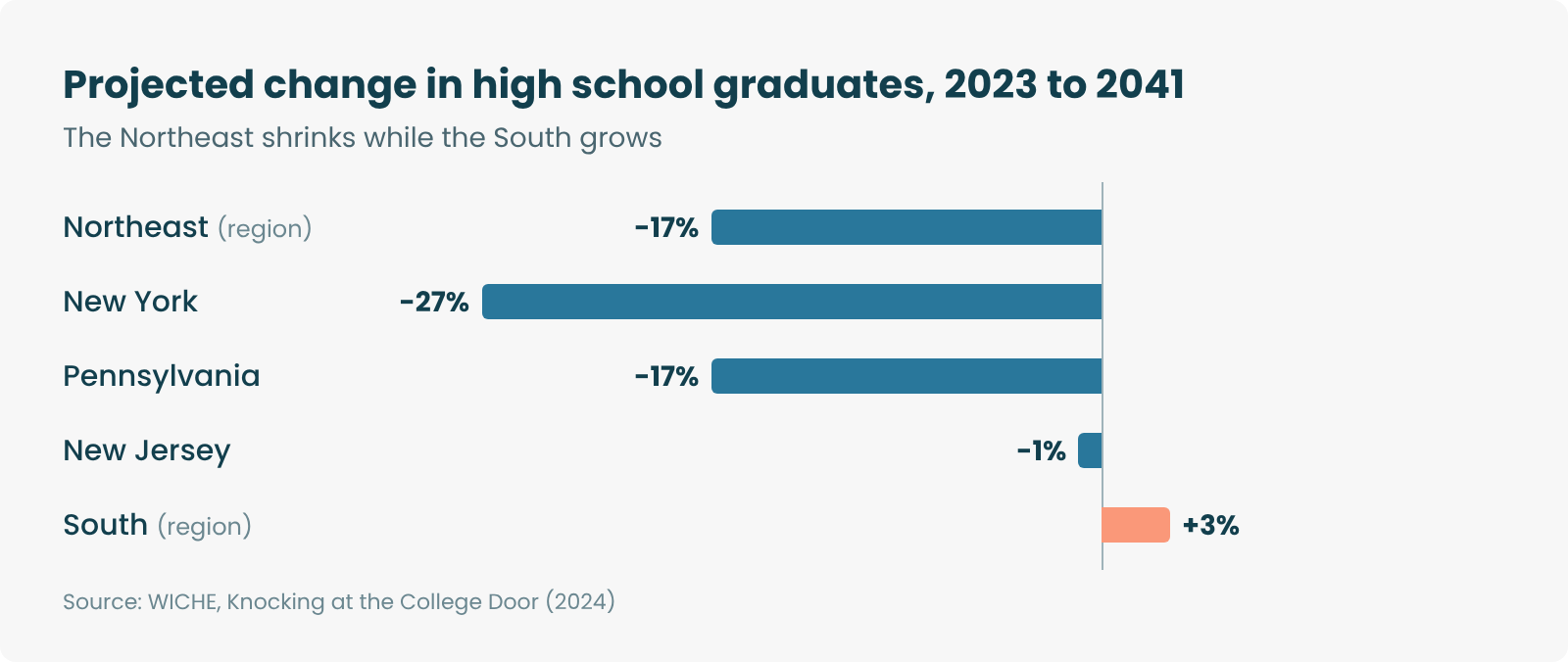
The East is 2 markets moving in opposite directions. WICHE projects the number of high school graduates in the Northeast will fall 17% between 2023 and 2041, while the South grows 3%. New York drops 27% over the same stretch and Pennsylvania drops 17%. New Jersey holds roughly flat.
Students are moving too. Enrollment of Northeast students at the University of Georgia rose 106% from 2014 to 2023, according to an Axios analysis of NCES data. A Wall Street Journal analysis cited in the same piece found the number of students from the North at Southern public universities rose 84% over 2 decades.
For a Northeast institution, that means a smaller home pool with more outside recruiters working it. For a Southern or Mid-Atlantic institution, a growing pool draws new competition into schools you used to have mostly to yourself. Feeder schools up and down the East Coast are contested ground.
What do most student recruitment services cover?
Most of them start working once a student is identifiable: after a test registration, an interest form, a fair scan or an ad click. That's useful work, and it only reaches students who've already raised their hand.
Most students don't. About 61% of students in Spark451's 2026 survey of college-bound students and parents never submitted an inquiry or form to a college. Of those who did, more than half did it only because it was required.
So a recruitment plan can look complete on paper and still miss most of the students in your priority schools during the years their preferences form. You can't performance-market your way into a high school hallway.
What should colleges look for in a student recruitment partner?
These are the questions we'd ask of any partner, including us.
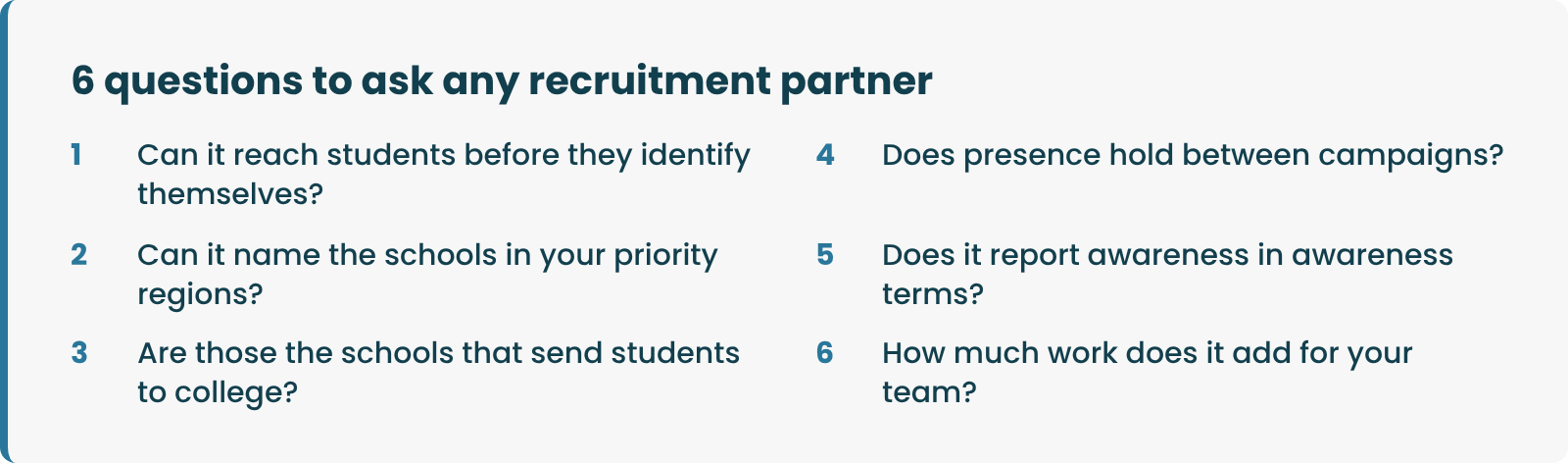
Can it reach students before they identify themselves? If a service needs a name, an email or a click before it can do anything, it's working with the minority of students who've raised their hand.
Can it name the schools? Ask for a school-by-school list in your priority regions. Coverage described only as a metro area or a radius makes it hard to know whether your top feeder schools are included.
Are they the right schools? In a shrinking Northeast pool, the schools worth holding are the ones that send students to college in volume, including large publics, magnet schools and schools with IB, AP Capstone or early college pathways.
Does presence hold between campaigns? A fall push fades by spring, and the 10th graders in the building barely registered it. Ask what students in your priority schools see in January, in April and over the months when you're not recruiting.
Does it report honestly? Awareness work should be reported as reach, impressions, frequency and coverage in your target schools. A partner promising click-level attribution from an awareness channel is overselling it.
How much work does it add? Your team is already stretched. A good service runs with light ongoing management once your creative is in.
Where does OnDeck fit in the Eastern U.S.?
We built our in-school screen network school by school, around feeder schools that send students to college in volume. In the East, we have established coverage in Massachusetts and a growing footprint across the rest of the Eastern U.S., especially in Maryland, Virginia and Pennsylvania.
A few of the names you'll recognize: Boston Latin School, Andover High School and the Advanced Math & Science Academy in Massachusetts. Montgomery Blair and Bethesda-Chevy Chase in Maryland. Radnor, State College Area and Hopewell Valley Central in Pennsylvania and New Jersey.
Our screens are full-height, always-on displays in the hallways students walk between classes. You pick your regions and send creative, and we handle placement, scheduling and upkeep. The full network covers 750+ schools across North America, and we pair it with digital campaigns that carry the same message into the rest of a student's week.
How do you know if it's working?
Track it the way you'd track any awareness investment. Compare application activity and branded search from covered schools and regions against markets outside your footprint, and watch the trend across terms. The relationship you're looking for is correlation, and it takes more than one cycle to read.
Where to start
Pull your top 20 feeder schools in the East and sort them by state. Check each state's graduate projection. Then ask every partner you're evaluating which of those schools they can put you in, and how often a student in each one sees your name in a typical week.
If you'd like to see which of your Eastern feeder schools are already in our network, get in touch with our team!
