

Every marketing leader in higher ed has sat in the meeting. Someone across the table is viewing a spreadsheet and asking for attribution data on a channel that runs on an 18-month decision cycle.
That meeting was the focus of our panel at the recent 2026 AMA Symposium for the Marketing of Higher Education in Aurora, Colorado. John Reid of OnDeck moderated Defending Brand Awareness and Reputation Inside a Performance-Obsessed Institution, with 3 panelists representing different corners of the higher ed leadership sphere.
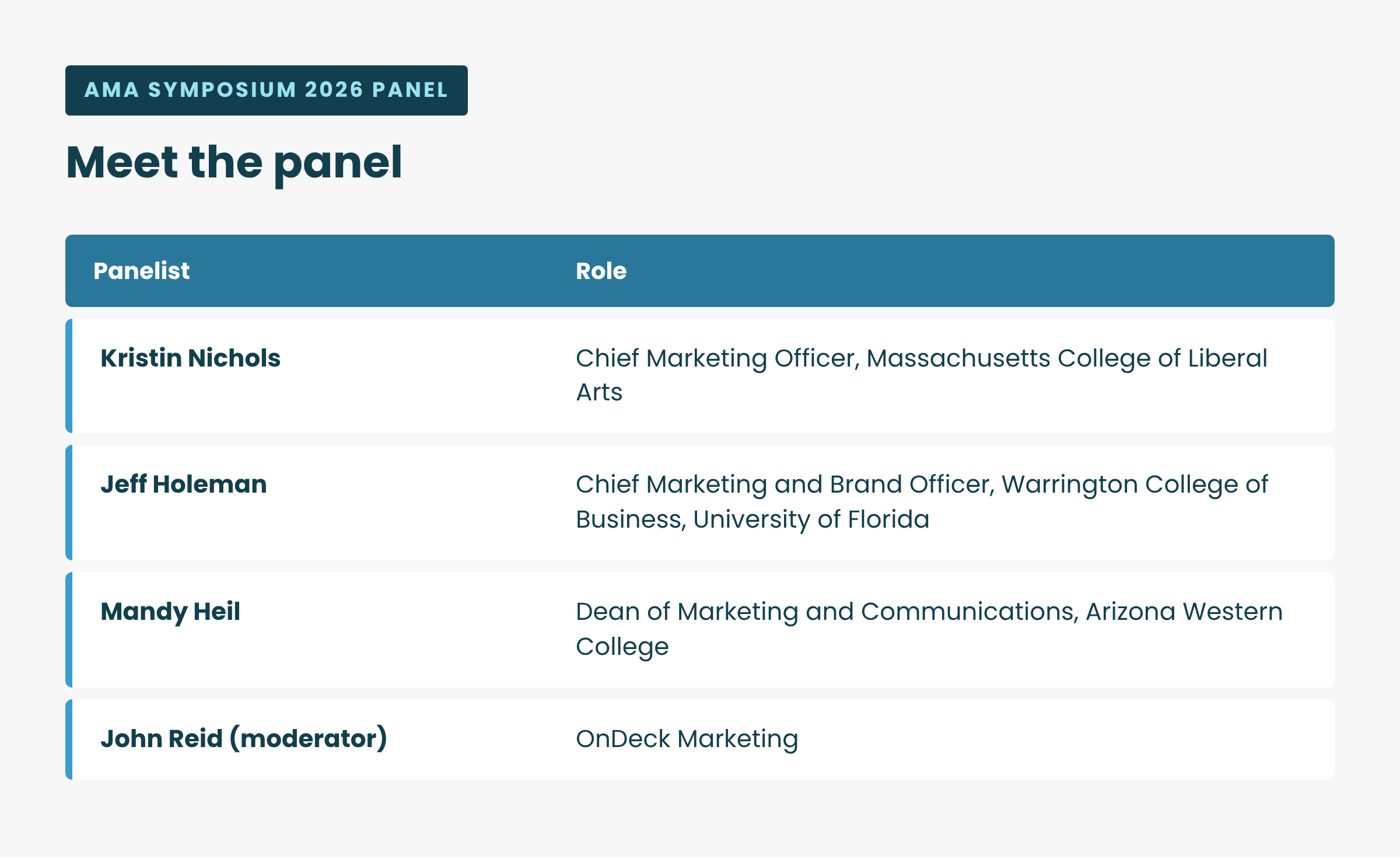
The session started from a premise the whole room already shared: awareness works. The hard part is the budget conversation, and that conversation runs on politics long before it gets to measurement. Here's some of the highlights our panelists brought to the table.
The toughest objection is often decided before you walk in
Jeff Holeman opened with his personal experience of a budget meeting that went sideways. He went to his CFO to fund a reputation campaign, with what looked like an airtight case: U.S. News ranks undergraduate business programs entirely on peer reputation, and reputation weighs heavily in MBA rankings too.
The catch was history. The CFO had spent years trying to move those same rankings in a previous role and had already concluded the effort wouldn't pay off. He asked for a full media plan and a guaranteed lift in reputation score. Jeff didn't get the funding.
Looking back, Jeff said the CFO was right to ask for accountability. What he'd change is the shape of the ask: a phased investment with progress indicators and checkpoints to evaluate results, so a skeptical finance lead has a way in without a leap of faith. His bigger lesson was about preparation. He'd built a defense of a marketing plan, and the person across the table needed help reconsidering a conclusion he'd reached years earlier.
Saying the hard thing out loud, with data behind it
Kristin Nichols shared a moment from before she joined MCLA full time, when she was consulting for the college. After a painful enrollment year, the reflex at many institutions is to cut marketing to close the financial gap. Sitting with the chief of staff, the provost and enrollment leadership, Kristin told them, as graciously as possible, that the college had gone silent in market and wouldn't succeed until that changed.
Her contract was ending with the fiscal year, so she thanked them and started thinking about what was next. Leadership came back and hired her as the college's first CMO, with a mandate to build a budget and a marketing team. Her point to the room: a candid read, backed by data, sometimes takes a while to land.
Let the decision-maker make the argument for you
Jeff's second story went the other way. When he asked his former dean to fund a rebrand of the business school, he skipped the brand equity presentation. He asked the dean to name the 5 best public business schools in the country, then explain what made them the best.
The dean talked through faculty, research, outcomes and alumni, and nearly every answer circled back to reputation: what those schools were known for and what people believed about them. Jeff helped him connect those dots, then made his pitch. The dean funded the full project.
Jeff's takeaway was that the most persuasive evidence in a budget meeting often comes from the person across the table. Leaders already use brand to judge other institutions. Helping them see that gives them a reason to fund it on their own terms.
Defending brand when leadership wants every post to sell
Mandy Heil's version of this fight happens in strategy conversations more than budget meetings. Leadership regularly asks why every social post doesn't carry a call to action, why the team doesn't promote individual classes and why it spends time on lighter content.
Her team's answer is storytelling. Somos Western highlights students' experiences and reflects Arizona Western's Hispanic, multilingual community, with no registration push anywhere in it. The goal is for prospective students to see themselves at the college.
She also pointed to Flex+, a campaign that resonated with leadership. The brief was to promote short-term classes, and the team built the campaign around students designing a schedule that fits their lives, with 8-week classes, 16-week classes or a mix. Fall 8-week course enrollment rose 48% year over year.
Mandy's framing for all of it borrowed a line from a colleague in her state: marketing is asking someone out, and brand is the reason they say yes. A call to action works on people who already know and like the institution, and storytelling is how they get there.
The cost of going quiet shows up 2 cycles later
John framed the visibility gap for the room. When an institution stops showing up for students, nothing breaks that month, or for several months after. The impact arrives 2 or 3 cycles later as softer interest and students who never put the school on their list.
Each panelist's story traced back to that lag. Jeff's rankings case, Kristin's warning about going silent and Mandy's storytelling all argue for presence before the enrollment numbers force the conversation, when the gap is already expensive to close.
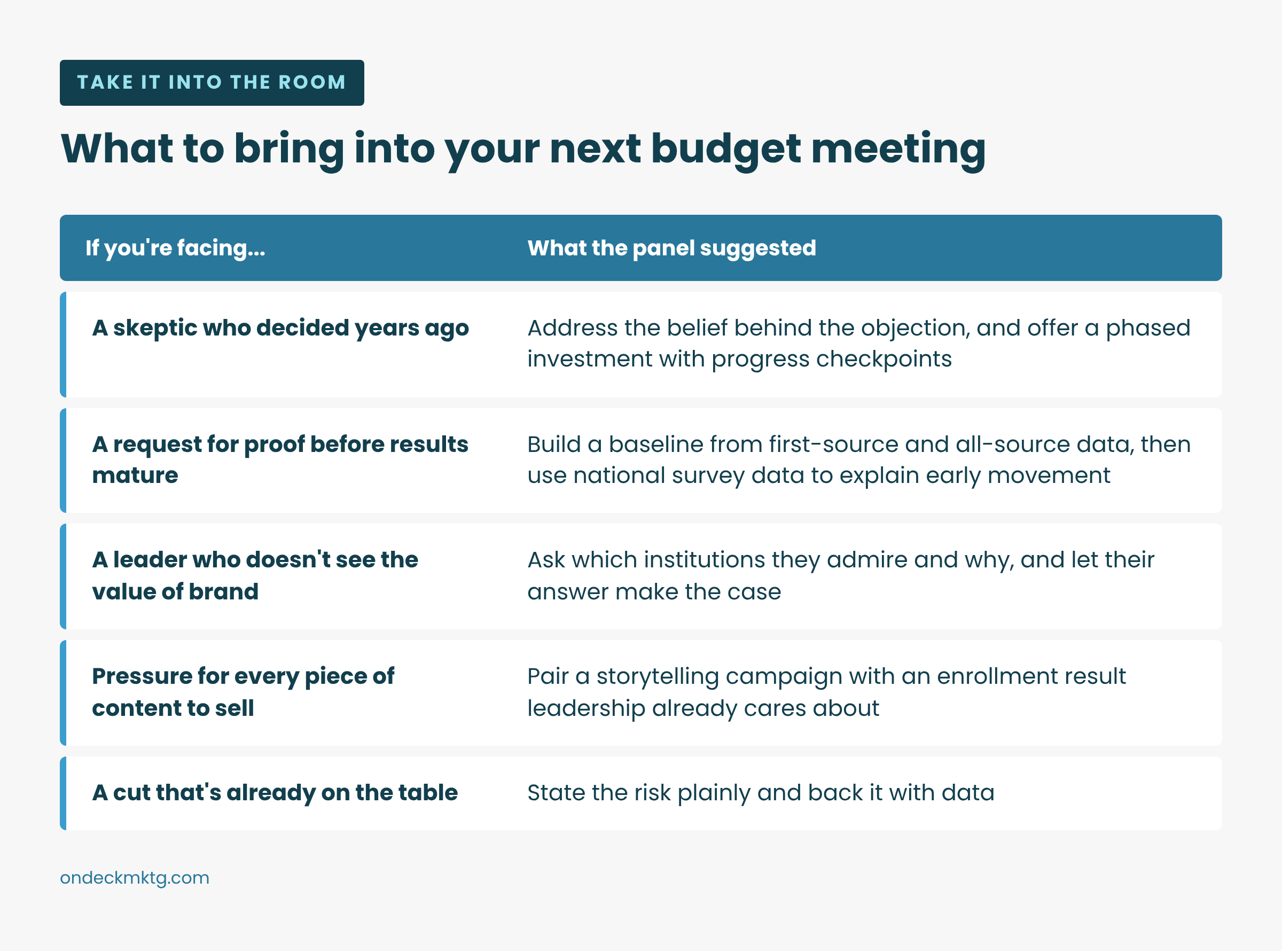
What to bring into your next budget meeting
Keep the conversation going
Two of our panelists posted their own candid reflections on LinkedIn. Jeff’s post covers how much brand dominated this year’s Symposium and his case for treating brand as the full student experience. Mandy’s post talks about bringing a community college perspective to the conversation on defending brand awareness.
A 50-minute panel only covers so much. We continue these conversations with higher ed marketing and enrollment leaders in OnDeck & OffScript, our unfiltered interview series. If you've got opinions on defending awareness spend, we've got a mic.
Thanks to Kristin, Jeff and Mandy for sharing what happens in those meetings, and to everyone who joined us at AMA.
